
Richland County Bankruptcy Records
Richland County is home to Columbia, the state capital of South Carolina, making it the political and administrative center of the state. The county's court and property records stretch back to 1781, but like Orangeburg County, Richland County suffered catastrophic records destruction during the Civil War. In February 1865, during the federal occupation of Columbia, the county courthouse was destroyed by fire, consuming most public records held there. Today, Richland County maintains a large and active court system with separate Clerk of Court and Register of Deeds offices, and all bankruptcy matters for county residents are handled by the U.S. Bankruptcy Court for the District of South Carolina. This guide covers the full range of resources for locating Richland County bankruptcy filings and associated public records.
Richland County Quick Facts
Richland County Clerk of Court
The Richland County Clerk of Court, currently The Hon. Jeanette W. McBride, serves one of South Carolina's largest and most active court systems. The mailing address is PO Box 2766, Columbia, SC 29202, and the office is located at the Richland County Government Center. The main phone number is (803) 576-1950, and office hours are Monday through Friday, 8:30 AM to 5:00 PM. The Clerk's official webpage at https://www.richlandcountysc.gov/Government/Elected-Offices/Clerk-of-Court provides contact details, service descriptions, and links to online court tools used in Richland County.
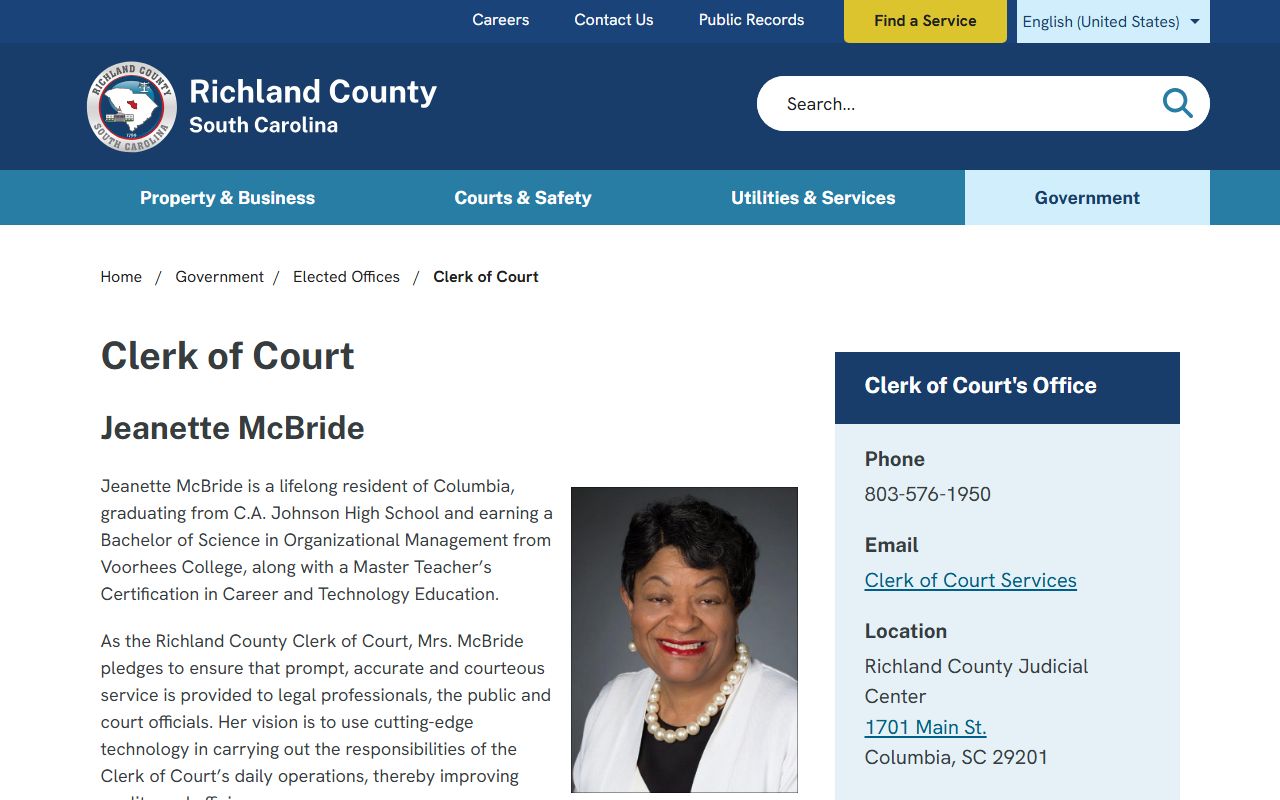
The Richland County Clerk of Court page shown above is the primary contact portal for circuit court and family court records in Columbia, providing information on fees, certified copy requests, and online tools for case research in the 5th Judicial Circuit. This is the appropriate starting point for any state-level court record inquiry in Richland County.
Richland County's public records page at https://www.richlandcountysc.gov/Government/Public-Records consolidates public records access information for the entire county government, including the Clerk's office and the Register of Deeds. For researchers who need to navigate multiple Richland County offices, this central page is a useful starting point before contacting individual departments.
Richland County Register of Deeds and Property Records
The Richland County Register of Deeds, currently The Hon. John Hopkins, operates from PO Box 192, Columbia, SC 29202, with the physical office at the Richland County Government Center. The office is open Monday through Friday, 8:30 AM to 5:00 PM, and is reachable at (803) 576-1910. The county's Mapping and Records division at https://www.richlandcountysc.gov/Property-Business/Mapping-and-Records provides online access to property records, mapping tools, and land record indexes.
The Richland County government website shown above provides access to the Register of Deeds office contact information, property mapping tools, and online deed record resources at the Richland County Government Center in Columbia. Bankruptcy trustees and property researchers will find this portal a useful starting point for Richland County real estate records.
Richland County's marriage index has been available online since 1911. The Register of Deeds maintains land records dating from 1865 following the Civil War courthouse fire. For bankruptcy asset research, deed records, mortgage filings, and judgment liens recorded at the Richland County ROD form a critical part of any debtor property investigation. State tax liens have been maintained separately on the SC DOR Lien Registry at https://dor.sc.gov/LienRegistry since November 1, 2019.
Note: Richland County's two separate offices for Clerk of Court and Register of Deeds mean that court record requests and property record requests go to different offices, even though both may be located at the Richland County Government Center.
Federal Bankruptcy Filings: PACER and the SC Bankruptcy Court
All Richland County bankruptcy cases are administered by the U.S. Bankruptcy Court for the District of South Carolina. The federal PACER system at https://pacer.uscourts.gov/find-case is the primary online tool for accessing those filings. PACER registration is free, and users can search by debtor name, case number, or business entity name. Document access is $0.10 per page, with any quarterly total under $30.00 automatically waived. As the state's capital and largest urban county, Richland County generates a significant volume of bankruptcy filings, and PACER's search tools are well-suited to navigating this volume.
The SC Bankruptcy Court operates from three division locations. The Columbia Division at 1100 Laurel Street is the most geographically proximate to Richland County and handles many Midlands area filings. The Charleston Division is at 145 King Street and the Greenville Division at 300 East Washington Street serve their respective regions. The court's website at https://www.scb.uscourts.gov/ provides all filing guides, local rules, and division contact information. The Case Information Portal at https://www.scb.uscourts.gov/case-information offers a streamlined case status lookup.
The Voice Case Information System at 1-866-222-8029 is available 24 hours a day, 7 days a week at no cost, covering cases filed after November 30, 1988. Callers receive case number, chapter type, filing date, trustee assignment, and current status including discharge or dismissal. For Richland County residents and creditors who need quick verification of a case status without logging into PACER, VCIS is a fast and free alternative. South Carolina Chapter 7 cases typically discharge within 90 to 120 days; Chapter 13 plans span 36 to 60 months.
Public Records Portal and Online Access Tools
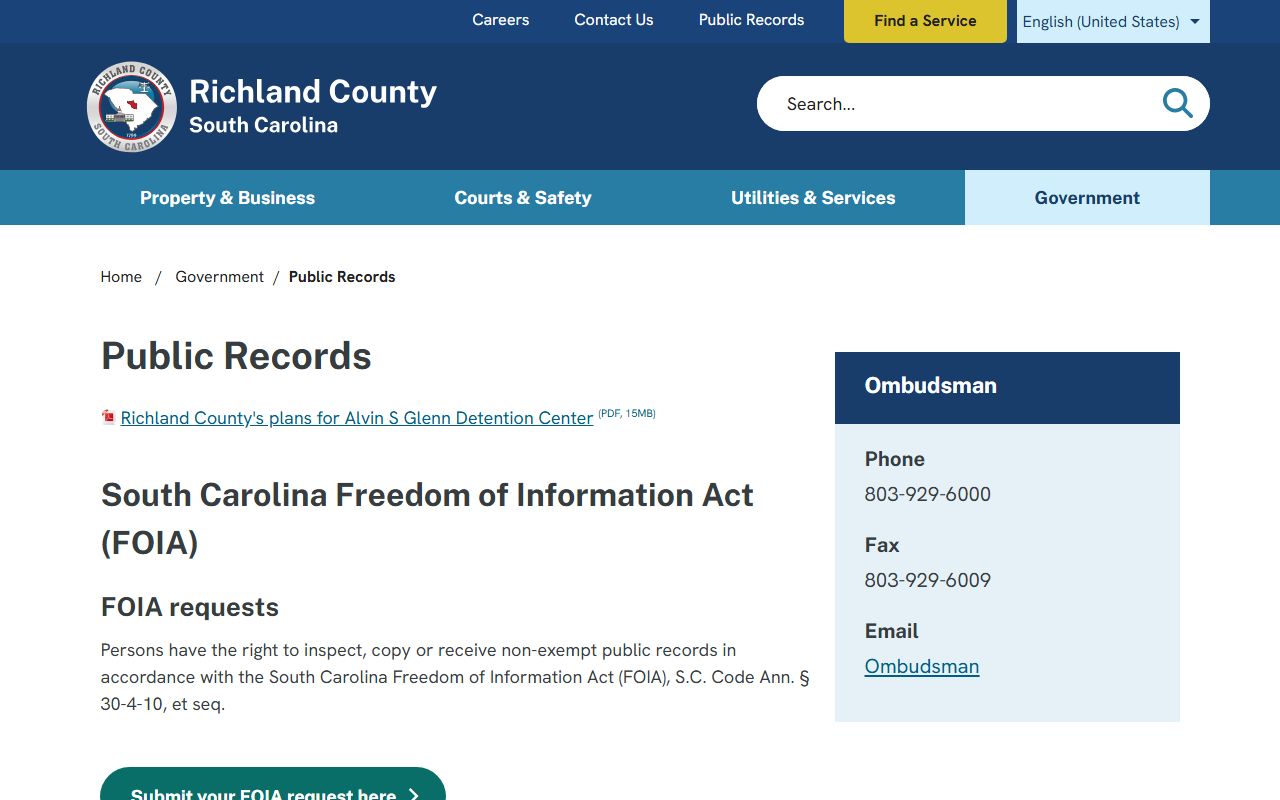
The Richland County Public Records portal shown above consolidates access information for all county government record types, including the Clerk of Court and Register of Deeds, making it a useful hub for researchers who need to navigate multiple Richland County offices or online tools for bankruptcy-related investigations.
The South Carolina Judicial Public Index for Richland County allows free searches of circuit and family court dockets. State court records including civil judgments, foreclosure actions, and domestic matters are searchable through this system. These state court records frequently intersect with federal bankruptcy cases when a creditor has obtained a judgment lien on a debtor's property or when a mortgage foreclosure was underway before a bankruptcy petition was filed. The automatic stay that accompanies a bankruptcy filing halts most state court collection proceedings, making the Public Index a useful tool for attorneys and creditors tracking which Richland County matters are stayed.
The 1865 Fire and Historical Records Availability
February 1865 marked a pivotal moment in Richland County records history. The federal occupation of Columbia resulted in the destruction of the county courthouse and most records held there. Equity and probate records were reportedly removed before the fire and thus survived, which is why Richland County probate records from the pre-Civil War era may still be accessible through the SC Department of Archives and History. Court records from 1781 to 1957 exist with fire damage, and land records from 1865 to 1951 cover the post-Civil War reconstruction period.
The SC Department of Archives and History at https://scdah.sc.gov/ holds the surviving pre-fire Richland County materials and can assist researchers seeking colonial-era or antebellum records that predate the 1865 destruction. SCDAH's holdings include microfilmed county records and some original documents that were either removed before the fire or reconstructed afterward. For archived federal bankruptcy cases no longer accessible through PACER, the National Archives and Records Administration's Atlanta Regional Archives at https://www.archives.gov/atlanta is the designated repository for South Carolina federal court records.
Legal Resources for Richland County Bankruptcy Matters
Richland County residents have access to an extensive network of legal and public records resources given the county's status as the state capital. SC Legal Services at https://sclegal.org/ provides free civil legal help to qualifying low-income residents, with an intake line at 1-888-346-5592. The South Carolina Bar's headquarters is located in Columbia, and the Bar's Lawyer Referral Service at 803-799-7100 connects residents with licensed attorneys for paid consultations. The SC Bar's full directory at https://www.scbar.com/ is organized by county and practice area, making it straightforward to find a Richland County bankruptcy attorney.
South Carolina's FOIA statute at S.C. Code Title 30, Chapter 4 governs all public records requests to Richland County government offices. Agencies must acknowledge requests within 10 business days and produce non-exempt records within 30 days. Public court records and deed records are available to any requestor under this statute. Richland County's size and resources mean that online access to many record types is more developed than in smaller counties, with deed indexes and some court records available online through county and state portals. South Carolina bankruptcy filings rose approximately 12% from 2024 to 2025, and Columbia area residents facing financial distress should explore their options early with a qualified bankruptcy attorney.
Cities in Richland County
Richland County's communities, including the state capital, are served by the county Clerk of Court and separate Register of Deeds at the Richland County Government Center in Columbia.
Nearby Counties with Bankruptcy Records
Counties adjacent to Richland are served by the same U.S. Bankruptcy Court district and maintain their own local court and property records offices in the Midlands region of South Carolina.