
Columbia Bankruptcy Records
Columbia bankruptcy records are filed with the U.S. Bankruptcy Court for the District of South Carolina's Columbia Division, located at 1100 Laurel Street, Columbia SC 29201. As South Carolina's state capital and the seat of Richland County, Columbia is home to the central division of the federal bankruptcy court and handles a high volume of Chapter 7, Chapter 11, and Chapter 13 filings. Residents and researchers can access case records through PACER, the free VCIS telephone line, and the city's own public records portals. This guide covers all available official channels for locating Columbia bankruptcy filings.
Columbia Quick Facts
U.S. Bankruptcy Court Columbia Division
The Columbia Division of the U.S. Bankruptcy Court for the District of South Carolina is located at 1100 Laurel Street, Columbia SC 29201. As the court's central division and home to the clerk's main office, the Columbia courthouse serves as the administrative hub for the entire district. All three divisions of the South Carolina federal bankruptcy court -- Charleston, Columbia, and Greenville -- share a single electronic docket, but cases are assigned to the division closest to the debtor's residence or principal place of business.
Chapter 7 cases filed in the Columbia Division typically close within 90 to 120 days when there are no assets to administer and no objections from creditors. Chapter 13 plans confirmed in Columbia run for 36 to 60 months and require monthly payments to a standing trustee. South Carolina saw a roughly 12 percent increase in total bankruptcy filings between 2024 and 2025, and Columbia, as the state's most populous metro area, accounts for a significant portion of that volume.
Note: The Columbia Division courthouse at 1100 Laurel Street is open during regular business hours; attorneys and registered CM/ECF users can file documents electronically at any time through the federal filing system.
PACER and VCIS Access for Columbia Cases
Federal bankruptcy case records for Columbia are accessible through PACER, the Public Access to Court Electronic Records system. PACER provides full document-level access to filed pleadings, schedules, creditor lists, trustee reports, and court orders. The cost is $0.10 per page, and accounts with quarterly charges under $30.00 are not billed. Researchers who only need case status -- such as filing date, chapter, trustee, and discharge information -- can use the free VCIS line at 1-866-222-8029, available 24 hours a day, seven days a week, for cases filed after November 30, 1988.
The court's case information page at scb.uscourts.gov/case-information provides direct links to PACER and VCIS instructions, along with additional search options. Searches can be conducted by debtor name, case number, or Social Security or tax ID number. Attorneys and pro se filers can also use the Case Management/Electronic Case Filing (CM/ECF) system to check the docket, review hearing schedules, and track deadlines in real time.
Note: PACER requires a registered account, which is free to create at pacer.uscourts.gov; the per-page fee is waived for any quarter in which total charges do not exceed $30.00.
Columbia City Clerk and FOIA Requests
The City of Columbia City Clerk is Erika D. Moore Hammond CMC, whose office is at 1737 Main Street, Columbia SC 29201. The office can be reached at (803) 545-3045 or by email at cityclerk@columbiasc.gov, and is open Monday through Friday from 8:30 AM to 5:00 PM. The official city clerk website is at cityclerk.columbiasc.gov. The clerk serves as the official custodian of all city legislative records, including council minutes, ordinances, resolutions, and official correspondence.
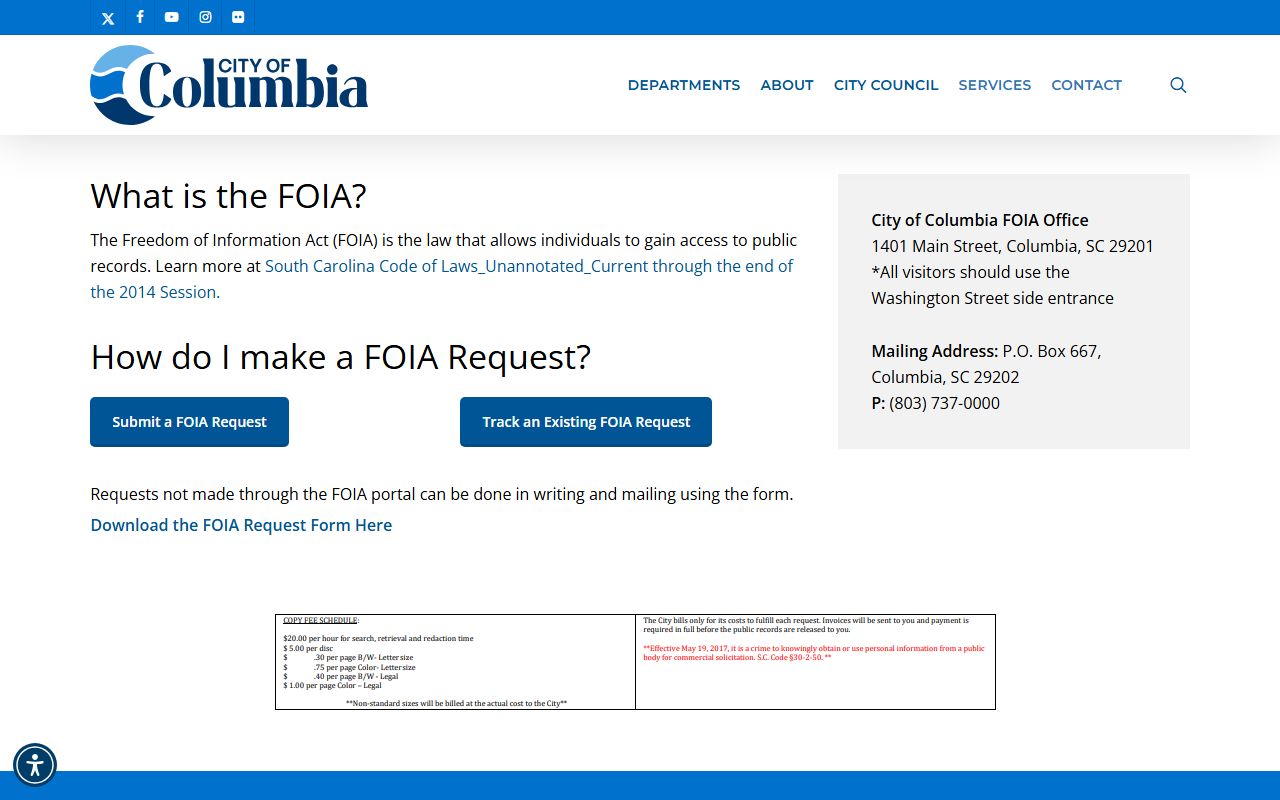
Public records requests for city-held documents can be submitted through the city's FOIA portal at columbiasc.justfoia.com/publicportal or by email to foia@columbiasc.gov. City records do not include federal bankruptcy filings, but may be relevant for researching city liens, business license records, or permit history that could appear in a bankruptcy filing's asset schedules or creditor lists.
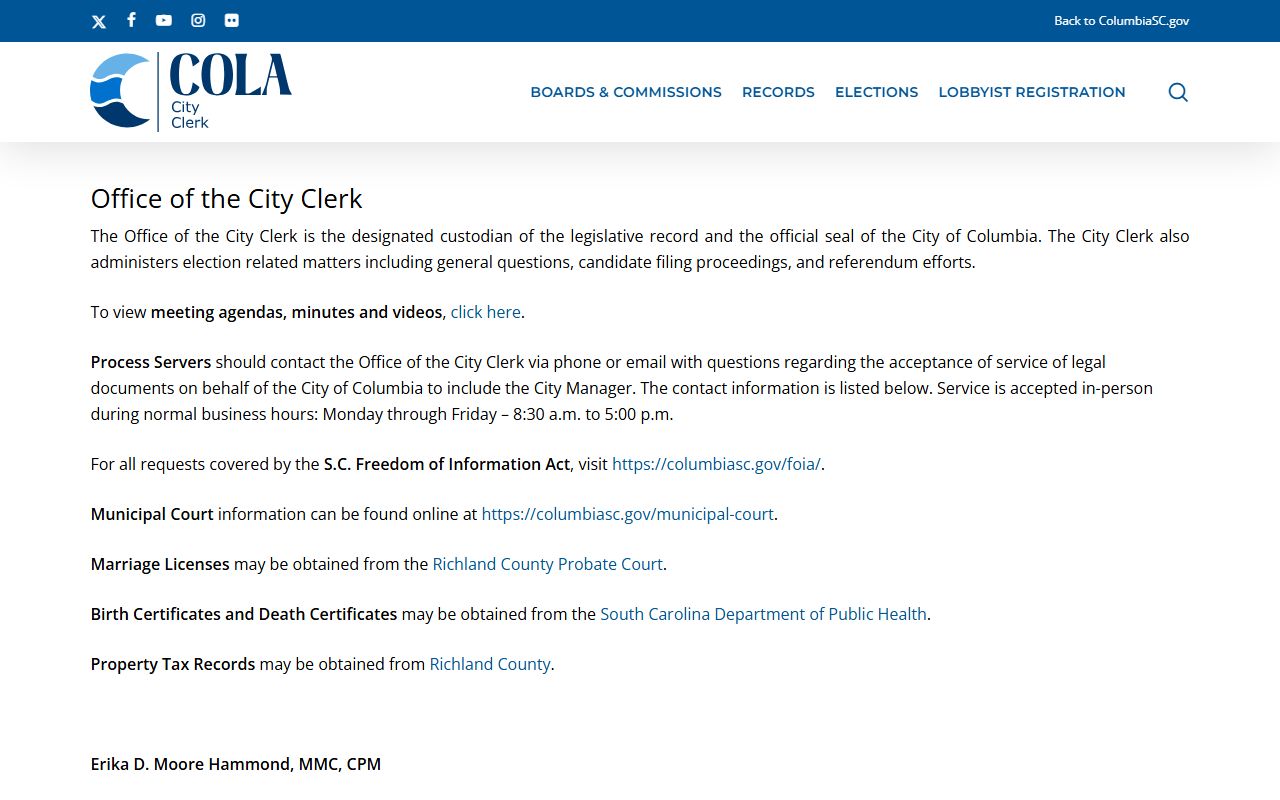
The Columbia City Clerk's Office at 1737 Main Street serves as the official repository for city legislative records and processes public records requests under the South Carolina Freedom of Information Act.
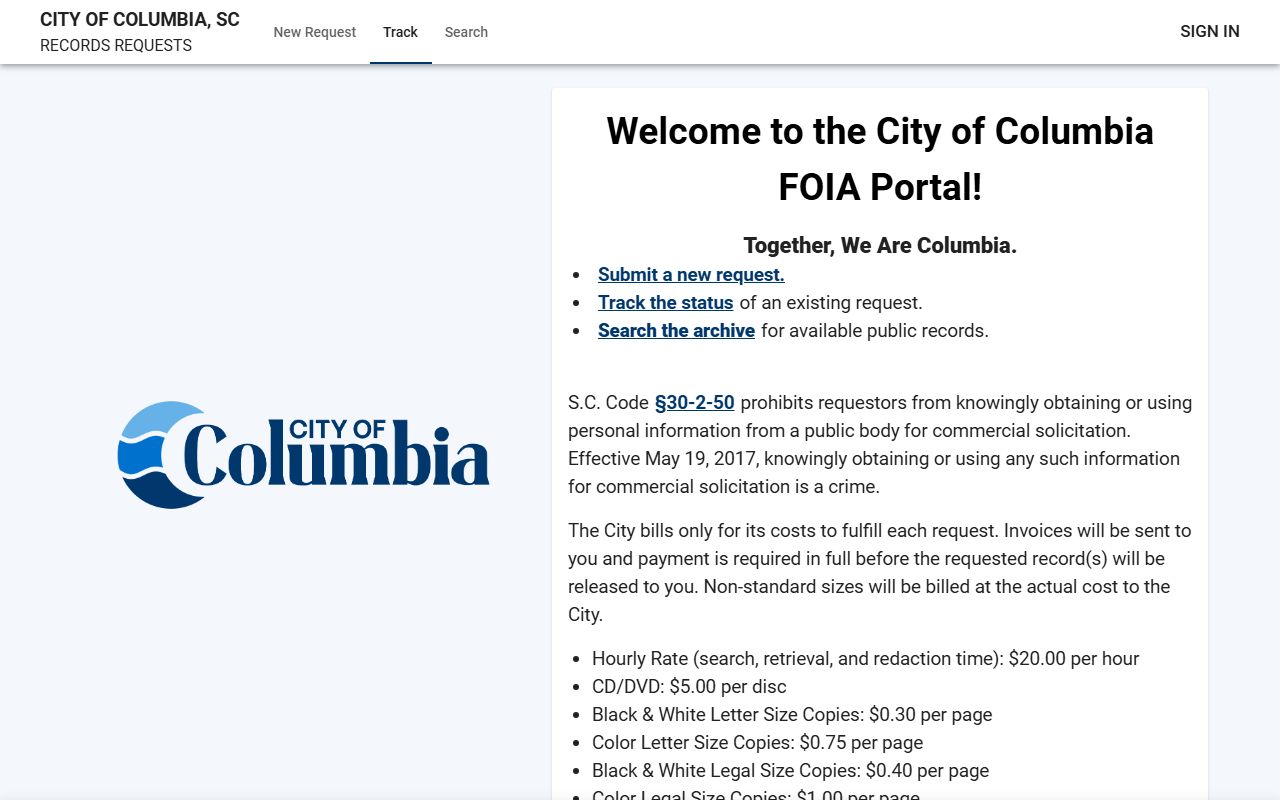
The Columbia FOIA portal at columbiasc.justfoia.com/publicportal allows residents to submit and track public records requests online without visiting city offices in person.
Note: The Columbia city FOIA portal handles requests for city-held records only; federal bankruptcy filings must be accessed through PACER or the federal court system, not through city channels.
Columbia Municipal Court Records
The Columbia Municipal Court is located at 811 Washington Street, Columbia SC 29201. The court handles misdemeanor criminal violations, traffic citations, and city ordinance offenses. Under S.C. Code § 14-25-45, Columbia Municipal Court is classified as a court "not of record," meaning its dockets are not part of the statewide SC Judicial Department Public Index. However, outstanding fines or judgments from municipal court can become city liens and may appear in a bankruptcy case as listed debts or priority creditor claims.
An online case search tool for Columbia Municipal Court is available at municipalcourt.columbiasc.gov/view-case-information/. The system covers records from 1988 to the present. When using the search, select "Columbia Municipal Court" from the court dropdown. The official municipal court page for the City of Columbia is at columbiasc.gov/municipal-court.
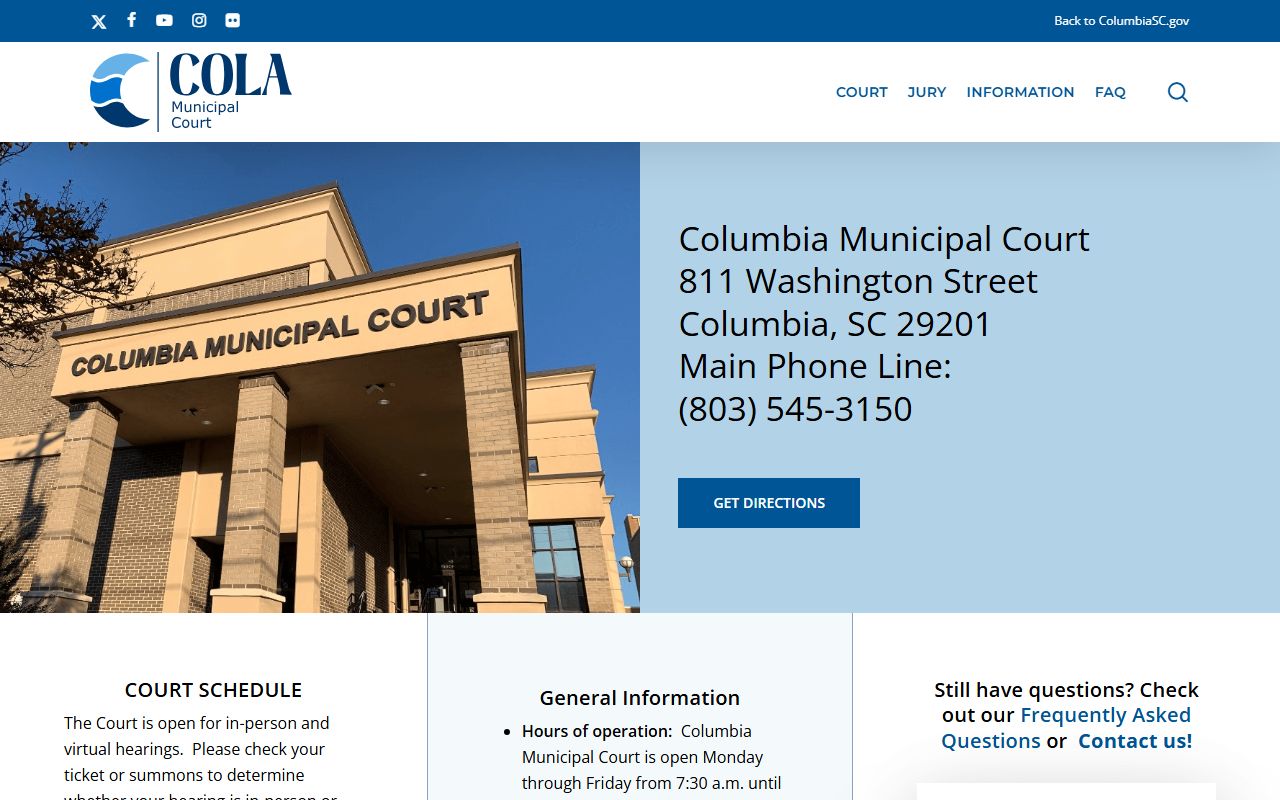
The Columbia Municipal Court page at columbiasc.gov/municipal-court provides information on court procedures, payment of fines, and access to the online case search portal.
The Columbia Municipal Court online case search at municipalcourt.columbiasc.gov covers city ordinance and traffic cases from 1988 forward, searchable by name or citation number.
Note: Columbia Municipal Court records from before 1988 are not available through the online search portal; requests for older records should be directed to the clerk of that court directly.
Richland County Clerk and State Court Records
The Richland County Clerk of Court is Jeanette W. McBride, reachable at (803) 576-1950. The Richland County clerk's office maintains state court records including civil judgments, family court orders, and criminal dispositions for cases within the county's circuit court system. These records are separate from federal bankruptcy filings but are frequently relevant when assessing the full scope of a debtor's legal history in the Columbia area.
State court judgment liens recorded in Richland County can affect real property owned by a debtor and may need to be addressed in a bankruptcy plan or lien avoidance motion. Researchers working on title searches or creditor due diligence in Columbia should check both the Richland County Clerk's records and the SC Judicial Department's Public Index. The SC Tax Lien Registry at dor.sc.gov/LienRegistry provides additional information on state tax liens that may be encumbering assets listed in a Columbia bankruptcy estate.
Note: Richland County Clerk records at the state level are distinct from federal bankruptcy records; both systems should be searched when conducting comprehensive due diligence on a Columbia-area debtor.
Historical Records and Archives for Columbia Cases
Older Columbia bankruptcy records that predate the PACER era may be held at the NARA Atlanta facility, which serves as the regional federal records repository for South Carolina. Researchers seeking original case files from the 1980s or earlier should contact NARA Atlanta directly to determine availability and access procedures. The South Carolina Department of Archives and History (SCDAH) in Columbia also maintains state and local government records, including older court documents and land records relevant to property matters in a bankruptcy estate.
Columbia's position as the state capital means that the SCDAH facility is located in the city itself, making in-person research more convenient than in other parts of the state. The SCDAH reading room is open to the public by appointment, and staff can assist with identifying relevant record series for both court and property research.
Note: NARA Atlanta handles federal court records for South Carolina; pre-PACER bankruptcy case files require a formal records request and may involve retrieval fees and delays.
Legal Assistance for Columbia Bankruptcy Filers
Columbia residents facing financial distress can contact the South Carolina Bar at 803-799-7100 or toll-free at 1-800-868-2284 for a lawyer referral. The SC Bar's referral service connects callers with licensed bankruptcy attorneys who practice in the Columbia area. Many attorneys in Columbia offer free or low-cost initial consultations for bankruptcy matters.
Residents who cannot afford private legal counsel may qualify for free assistance from SC Legal Services at 1-888-346-5592. SC Legal Services has a Columbia office and handles consumer bankruptcy questions, creditor harassment issues, and related financial legal matters. Income eligibility guidelines apply. The U.S. Bankruptcy Court's Columbia Division also provides self-help information at scb.uscourts.gov for those who choose to file without an attorney, though professional legal guidance is strongly advisable given the complexity of bankruptcy proceedings.
Note: The South Carolina Bar and SC Legal Services are separate organizations; the Bar's referral service connects callers with private attorneys, while SC Legal Services provides free representation to income-qualified individuals.
Columbia County Court Resources
All Columbia bankruptcy cases are handled by the Richland County court system and filed with the U.S. Bankruptcy Court for the District of South Carolina.