
Calhoun County Bankruptcy Records
Calhoun County residents and researchers looking for bankruptcy records have several avenues available through both federal and state systems. Because bankruptcy is a federal matter, Calhoun County cases are filed and maintained by the U.S. Bankruptcy Court for the District of South Carolina rather than the county courthouse. However, the Calhoun County Clerk of Court in St. Matthews holds complementary records including civil judgments, state tax liens, and property filings that frequently intersect with bankruptcy proceedings. This guide explains how each system works and how to locate the documents you need.
Calhoun County Quick Facts
Calhoun County Clerk of Court and Courthouse
The Calhoun County Clerk of Court serves as the county's primary record-keeper for state court proceedings and also performs Register of Deeds functions, as Calhoun does not maintain a separate ROD office. The Clerk's office is located at the Calhoun County Courthouse in St. Matthews, with a mailing address of P.O. Box 428, St. Matthews, SC 29135. You can reach the office by phone at (803) 874-3524 during regular business hours, Monday through Friday, 8:30 AM to 5:00 PM.
As part of the First Judicial Circuit, the Calhoun County Clerk manages a broad range of court records including General Sessions (criminal) and Common Pleas (civil) dockets, Family Court matters, land records and deed recording, UCC filings, child support records, and jury management. Because the Clerk also handles deed recording and land-related filings, a single visit to the courthouse often provides access to both court records and property-related documents relevant to a bankruptcy search. Researchers looking for the county's online court index should visit the South Carolina Judicial Public Index.
The South Carolina Courts website provides the official Calhoun County Clerk of Court contact details, and the image below shows what that resource page looks like for the county.
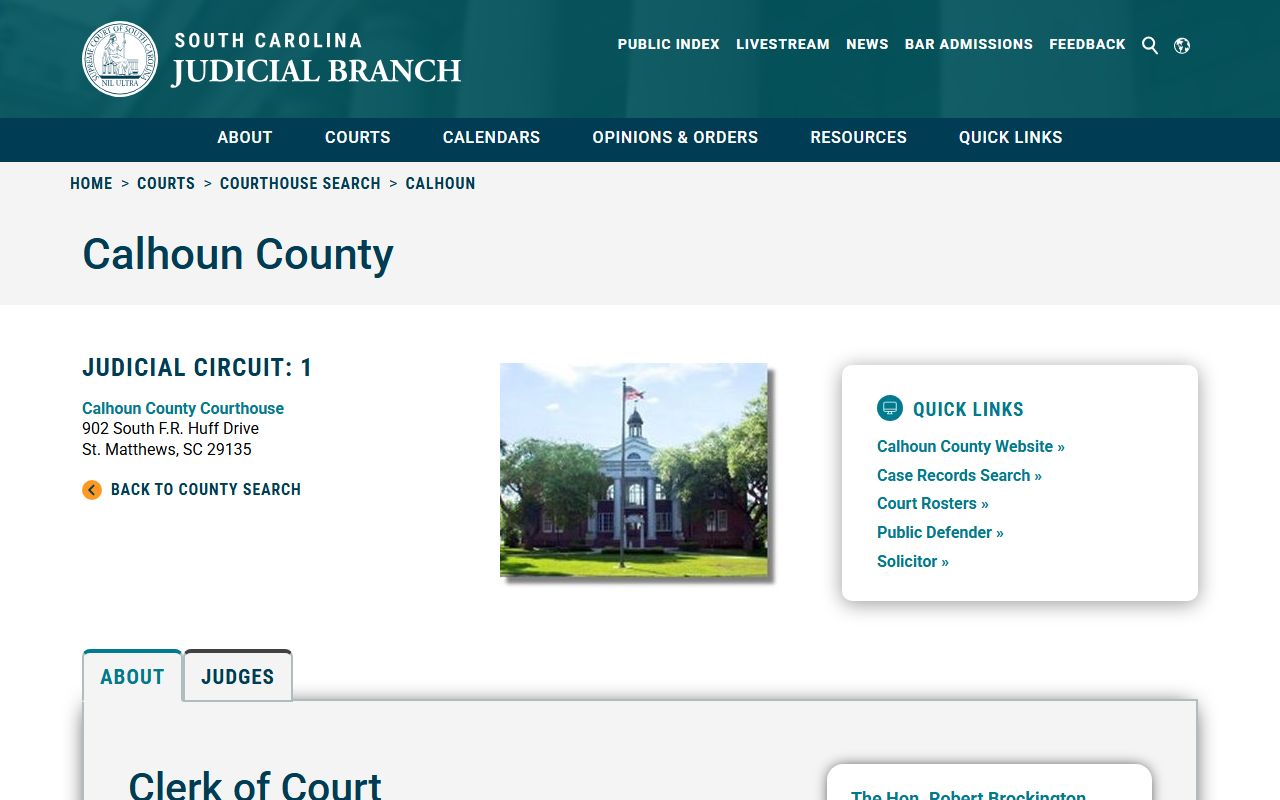
That page is maintained by the South Carolina Judicial Branch and is updated whenever contact information or office details change, making it a reliable starting point for courthouse research.
Searching Calhoun County Bankruptcy Records Through PACER and Federal Court
Because bankruptcy cases are filed under federal law, Calhoun County cases are heard by the U.S. Bankruptcy Court for the District of South Carolina. The court maintains three divisional offices: the Charleston Division at 145 King Street, the Columbia Division at 1100 Laurel Street, and the Greenville Division at 300 East Washington Street. Calhoun County filers typically appear in the Columbia Division given the county's geographic position in the central part of the state, though assignment can vary.
The primary online tool for accessing Calhoun County bankruptcy records is PACER, the Public Access to Court Electronic Records system, available at pacer.uscourts.gov. PACER charges $0.10 per page for documents retrieved, with a maximum of $3.00 per document. Quarterly fees under $30.00 are waived, making PACER essentially free for occasional personal use. Registered users can search by debtor name, case number, Social Security number, or taxpayer identification number to locate Calhoun County filings. Documents retrieved include the voluntary petition, schedules of assets and liabilities, statements of financial affairs, the bankruptcy plan (if a Chapter 13 case), and any discharge orders.
The U.S. Bankruptcy Court for the District of South Carolina also publishes case information directly on its website. The official U.S. Bankruptcy Court website serves as the central hub for Calhoun County filers, shown here.

That site provides links to CM/ECF for electronic filing, PACER case search, court calendars, local rules, and the court's frequently asked questions page covering Chapter 7, Chapter 11, and Chapter 13 procedures.
For those without a PACER account or who prefer a free option, the Voice Case Information System (VCIS) provides automated telephonic access to South Carolina bankruptcy case details. VCIS is available 24 hours a day, 7 days a week by calling 1-866-222-8029. The system covers cases filed after November 30, 1988, and allows callers to search by debtor name or case number. VCIS is entirely free and does not require any registration. You can also access VCIS information through the court's website at scb.uscourts.gov/vcis.
State Court Records and the SC Judicial Public Index
Not all financial and legal records associated with bankruptcy are found in federal court filings. Civil judgments, garnishment orders, and state-court debt collection actions in Calhoun County appear in the South Carolina Judicial Public Index, which is accessible online. The Public Index for Calhoun County is available at publicindex.sccourts.org/calhoun/publicindex/ and covers Common Pleas and General Sessions dockets maintained by the Clerk's office.
The South Carolina Judicial Public Index for Calhoun County allows users to search court filings and case records online, as shown in the screenshot below.
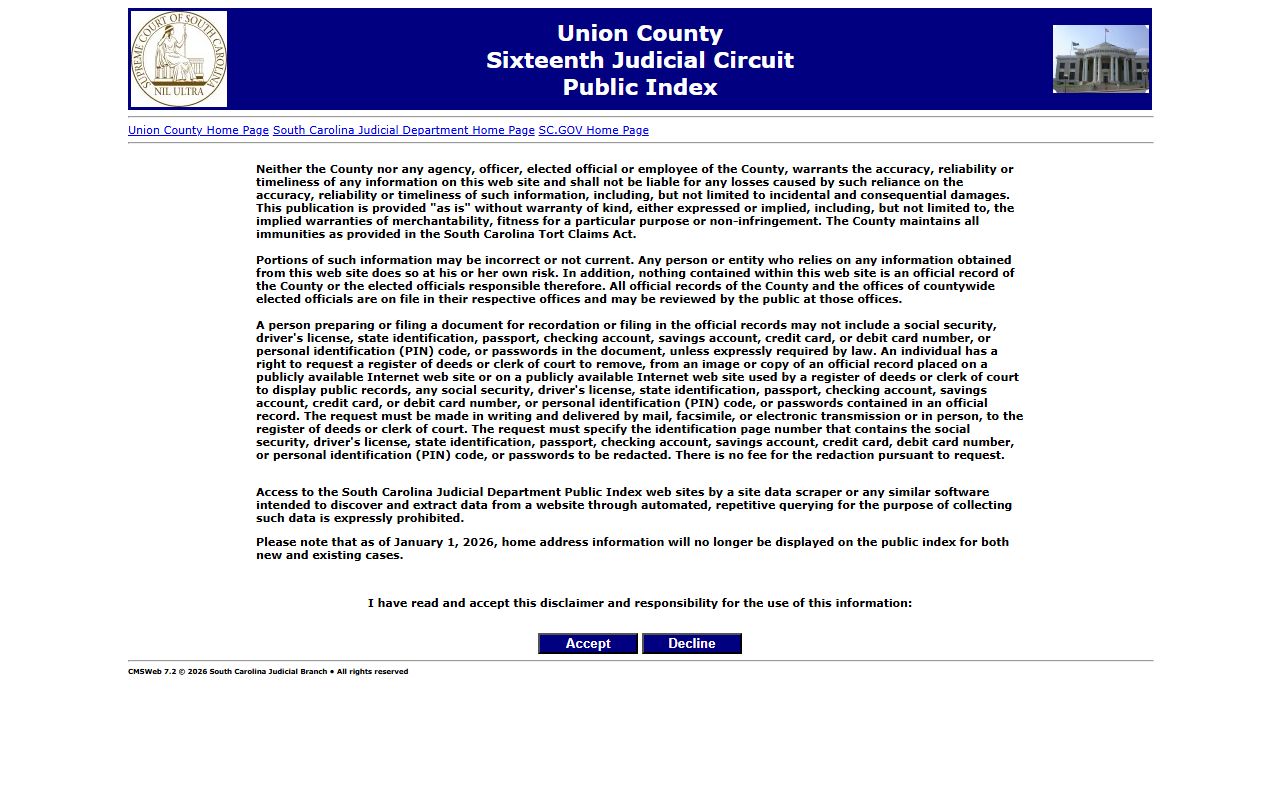
The Public Index is a useful tool for verifying whether a civil judgment in Calhoun County may have been included in or discharged through a bankruptcy proceeding, as the two systems can be cross-referenced by debtor name and filing dates.
Researchers should be aware that civil judgments recorded in the Calhoun County Clerk's office can become liens on real property located in Calhoun County. When a debtor files for bankruptcy, an automatic stay immediately halts most collection actions, but pre-existing judgment liens recorded in the state court system may survive bankruptcy unless separately avoided through a lien avoidance motion. Reviewing both the federal bankruptcy record and the state civil court index provides a complete picture of a debtor's obligations.
Property Records and Tax Liens in Calhoun County Bankruptcy Research
The Calhoun County Clerk of Court, in its capacity as Register of Deeds, maintains land records and deed recordings dating to 1908. These records include deeds, mortgages, plats, and related instruments. When researching a Calhoun County bankruptcy, property records help identify real estate assets that may be listed in the bankruptcy estate, encumbrances that a trustee must address, and transfers that may be subject to scrutiny as potential fraudulent conveyances under federal bankruptcy law.
State tax liens in Calhoun County are no longer recorded exclusively at the local courthouse. Since November 1, 2019, the South Carolina Department of Revenue has maintained a centralized online registry for state tax liens. You can search this registry at dor.sc.gov/LienRegistry. This is particularly important in bankruptcy cases because outstanding state tax obligations may be priority debts under the Bankruptcy Code, and the lien registry shows whether a state tax lien has attached to property before the bankruptcy petition date. Federal tax liens filed by the IRS in South Carolina are recorded with the South Carolina Secretary of State's office and can also be searched online.
UCC financing statements, which reflect secured creditors with interests in personal property, are also managed through the Clerk's office for Calhoun County. These filings matter in bankruptcy because they establish which creditors hold secured claims against business equipment, inventory, accounts receivable, and other personal property assets of the bankruptcy debtor.
Calhoun County Historical Records and Formation
Calhoun County was created in 1908 from portions of Lexington and Orangeburg Counties and was named in honor of South Carolina statesman John C. Calhoun. As one of South Carolina's smaller counties by population, Calhoun County maintains records dating to its formation year, 1908, for both court proceedings and land documents. Researchers needing records predating 1908 must look to the parent counties: Lexington County for records from that portion of the current county's territory, and Orangeburg County for records from the Orangeburg-derived portion.
Important caveats apply to those parent county archives. Lexington County's pre-1839 courthouse records were largely destroyed, and Orangeburg County's records suffered significant losses before 1865. Anyone tracing historical property chains or debt obligations in what is now Calhoun County should contact the South Carolina Department of Archives and History at scdah.sc.gov for guidance on surviving records from those earlier periods. The Archives holds microfilmed copies of many early South Carolina court and land records that may fill gaps left by courthouse destructions.
Public Access, FOIA, and Obtaining Copies in Calhoun County
Most Calhoun County court records maintained by the Clerk of Court are public records under South Carolina law. The South Carolina Freedom of Information Act, codified at S.C. Code Title 30, Chapter 4, governs access to public records held by state and local agencies. Under this statute, agencies generally must respond to a records request within 10 business days of receipt, either by providing the records, denying access with a stated reason, or providing a timeline for a more complex response. The Clerk of Court can be contacted at (803) 874-3524 to ask about specific record availability and any applicable copy fees before submitting a formal request.
Federal bankruptcy court records are governed by separate federal rules under the Bankruptcy Code and the Federal Rules of Bankruptcy Procedure. Most documents in a bankruptcy case are publicly accessible through PACER unless the court has issued a sealing order. Certain sensitive personal information, such as full Social Security numbers and financial account numbers, is redacted from publicly accessible filings under Federal Rule of Bankruptcy Procedure 9037. The court's case information page at scb.uscourts.gov/case-information explains what is available and how to request copies of paper documents from the clerk's office at the Columbia or Charleston division.
For historical Calhoun County records not available online, the South Carolina Archives in Columbia holds microfilm and original records from county courts across the state. The National Archives and Records Administration's Atlanta regional facility also holds certain federal court records for older South Carolina cases predating electronic filing systems.
Finding Legal Help for Calhoun County Bankruptcy Matters
Individuals in Calhoun County who are considering bankruptcy or who need help understanding bankruptcy records have access to several legal assistance resources. The U.S. Bankruptcy Court's frequently asked questions page at scb.uscourts.gov/court-info/faq covers common questions about the filing process, automatic stays, discharge eligibility, and the differences between Chapter 7, Chapter 11, and Chapter 13 cases. Chapter 7 cases in South Carolina typically result in a discharge within 90 to 120 days of filing for qualifying debtors. Chapter 13 cases involve a repayment plan lasting 36 to 60 months.
South Carolina Legal Services provides free civil legal help to qualifying low-income residents statewide. Their intake line is 1-888-346-5592. The South Carolina Bar Lawyer Referral Service can connect Calhoun County residents with private bankruptcy attorneys; the Bar can be reached at 803-799-7100 or toll-free at 1-800-868-2284, and their website is at scbar.com. South Carolina has seen a notable increase in bankruptcy filings in the 2024 to 2025 period, with filings rising approximately 12 percent statewide, making timely legal consultation increasingly important for those facing financial difficulty.
Cities in Calhoun County
Calhoun County is a small, rural county with St. Matthews serving as the county seat and the center of county government. The county does not include any large incorporated cities beyond its smaller communities, reflecting its status as one of South Carolina's least populous counties.
Nearby Counties
Calhoun County borders several counties in the central South Carolina region. Researchers tracing records that may cross county lines, or individuals whose property spans multiple counties, should also consult the records held by neighboring county clerks and registers of deeds.