
Anderson County Bankruptcy Records
Anderson County bankruptcy records are part of the federal court system and are accessible through PACER, the free VCIS phone line, and the U.S. Bankruptcy Court for the District of South Carolina. Anderson County is one of the larger upstate counties, with a dedicated Clerk of Court office, a separate appointed Register of Deeds, and multiple online portals for public record access. Residents and researchers searching for Anderson County bankruptcy records will find a range of resources at both the federal and county level, including the county's own ACPASS public database system and the South Carolina Judicial Public Index.
Anderson County Quick Facts
Anderson County Clerk of Court and Bankruptcy Case Records
The Anderson County Clerk of Court, C. Reena Thomason, maintains the official county-level court records for cases in the 10th Judicial Circuit. The Clerk's office is located at 100 South Main Street, Anderson, SC 29624 and can be reached at (864) 260-4053. Office hours are Monday through Friday, 8:30 AM to 5:00 PM. The Clerk's website at andersoncountycourts.org and the county courts portal at andersoncountycourts.org provide access to a wide range of public court records.
The Clerk's office is organized into several divisions: Administration, Civil and Criminal Courts, Family Court, Probate Court, and Records Management. The office handles marriage licenses, passport processing, court records maintenance, case management, and child support. For Anderson County bankruptcy records research, the Civil and Criminal Courts division is the most relevant at the county level, as it manages the civil dockets that may contain pre-petition judgments and post-discharge satisfaction notices related to bankruptcy cases.
Anderson County courts handle Circuit Court civil matters where the amount in controversy exceeds $7,500 and all criminal felony matters, Family Court cases including divorce and custody, Probate Court for estates and wills, and municipal court proceedings. The public records page at the county courts portal provides details on what is available online and how to request certified copies.
The Anderson County Clerk of Court website is shown below, illustrating the range of services and public access options available for Anderson County bankruptcy and civil records research.
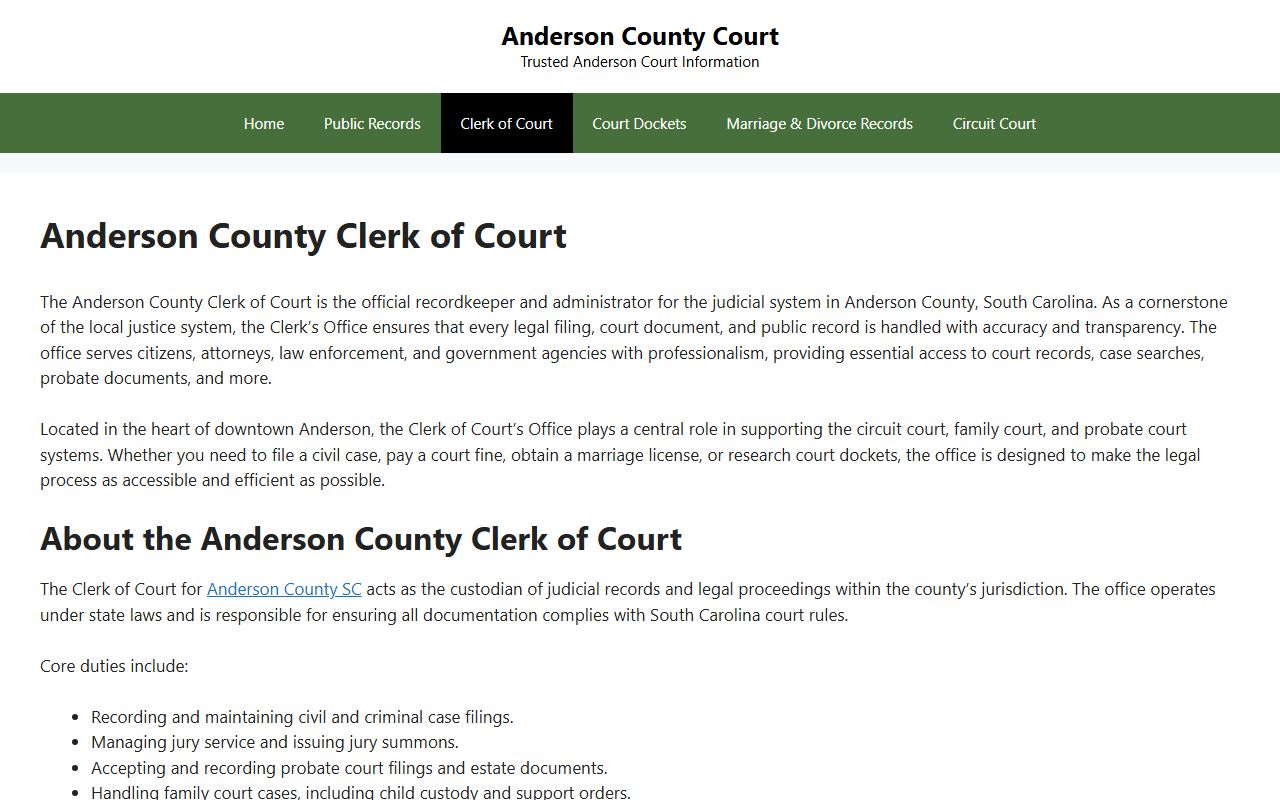
The Clerk's website at andersoncountycourts.org is the primary county-level resource for confirming which Anderson County court records are available online and which require an in-person visit or certified copy request.
Searching Anderson County Bankruptcy Records Online
Anderson County offers more online search tools than most South Carolina counties. The county's ACPASS system at acpass.andersoncountysc.org provides public access to Anderson County records through a searchable database. Researchers can use ACPASS to locate civil judgments, lien information, and other county-level records that may intersect with Anderson County bankruptcy filings.
The South Carolina Judicial Public Index for Anderson County provides free access to civil, criminal, and family court records through the statewide system. Searches can be conducted by party name, case number, filing date, and other criteria. Most Anderson County court records are available online, and the index shows party names, case type, judge assignment, charges, and docket actions. Certified copies of court records are available from the Clerk's office, with applicable copy fees.
For federal bankruptcy records, PACER is the definitive source. Anderson County bankruptcy cases are processed through the Greenville Division of the U.S. Bankruptcy Court at 300 East Washington Street, Greenville, SC, given the county's location in upstate South Carolina. PACER charges $0.10 per page with a $3.00 maximum per document, and quarterly charges under $30.00 are waived automatically.
The Anderson County Courts portal, shown below, consolidates access to multiple court systems and public record types relevant to Anderson County bankruptcy research.
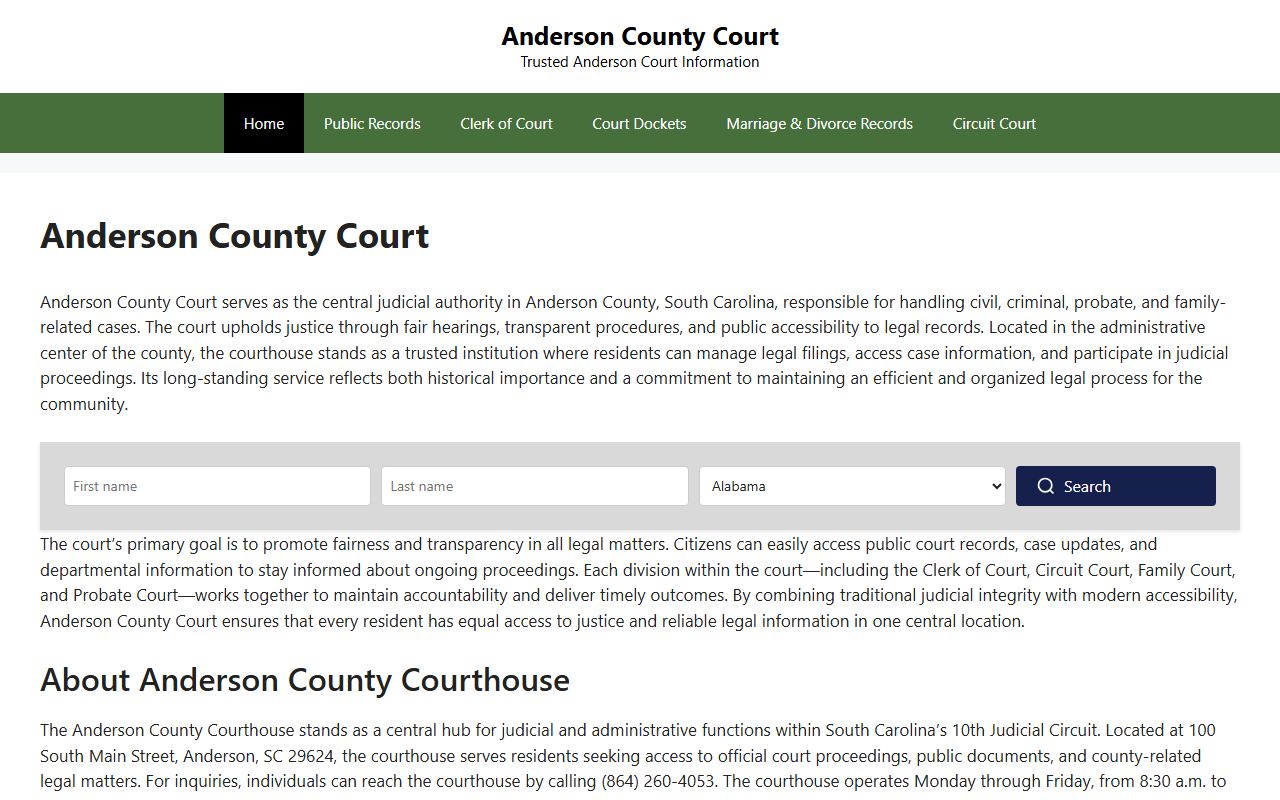
This portal at andersoncountycourts.org serves as a central hub for Anderson County court records and is a useful starting point for any bankruptcy-related records search in the county.
PACER, VCIS, and Federal Bankruptcy Court Resources
The U.S. Bankruptcy Court for the District of South Carolina handles all Anderson County bankruptcy filings under the federal Bankruptcy Code. Chapter 7 liquidation cases are the most commonly filed, with discharge typically occurring within 90 to 120 days of the filing date. Chapter 13 cases allow individuals to repay debts over a 36- to 60-month plan while retaining property. Chapter 11 reorganization and Chapter 12 family farmer cases are less common but available to Anderson County filers who qualify.
The free VCIS line at 1-866-222-8029 operates 24 hours a day, 7 days a week. Callers can obtain basic case information including the debtor's name, case number, chapter type, filing date, trustee assignment, and current case status for Anderson County bankruptcy cases filed after November 30, 1988. No account or fee is required to use VCIS.
For more detailed case information, CM/ECF and WebPacer are available to registered court users. The court's FAQ page explains each chapter type in plain language and is a useful free resource before filing or conducting research.
Note: Statewide bankruptcy filings rose approximately 12% from 2024 to 2025, reflecting economic pressures that have affected Anderson County residents along with the rest of South Carolina.
Anderson County Register of Deeds and Property Records
Anderson County has a separate appointed Register of Deeds office, located at 101 S. Main St., Box 8002, Anderson, SC 29622, reachable at (864) 260-1052. The ROD maintains deeds, mortgages, plats, surveys, and UCC filings for property in Anderson County. When a bankruptcy discharge results in a lien release or mortgage satisfaction in Anderson County, the corresponding document is recorded with the Register of Deeds. Researchers cross-referencing Anderson County bankruptcy records with property encumbrances should search the ROD's records in addition to PACER.
State tax liens filed before November 1, 2019 may appear in the ROD's records, while liens filed on or after that date are tracked through the SC Department of Revenue Lien Registry. The SC Land Records portal provides online access to recorded instruments in Anderson County. Federal tax liens are recorded with the county and indexed in the ROD's lien records.
One notable feature of Anderson County's records collection is that the county holds Pickens Area land records from 1789 to 1826, covering the Pendleton District era before Pickens County was formed. Researchers tracing historical property chains for Anderson County bankruptcy cases involving older land titles may need to consult these early records through the Clerk or ROD office.
The Anderson County public records page, shown below, outlines what is available online and through in-person requests for Anderson County court and property records.
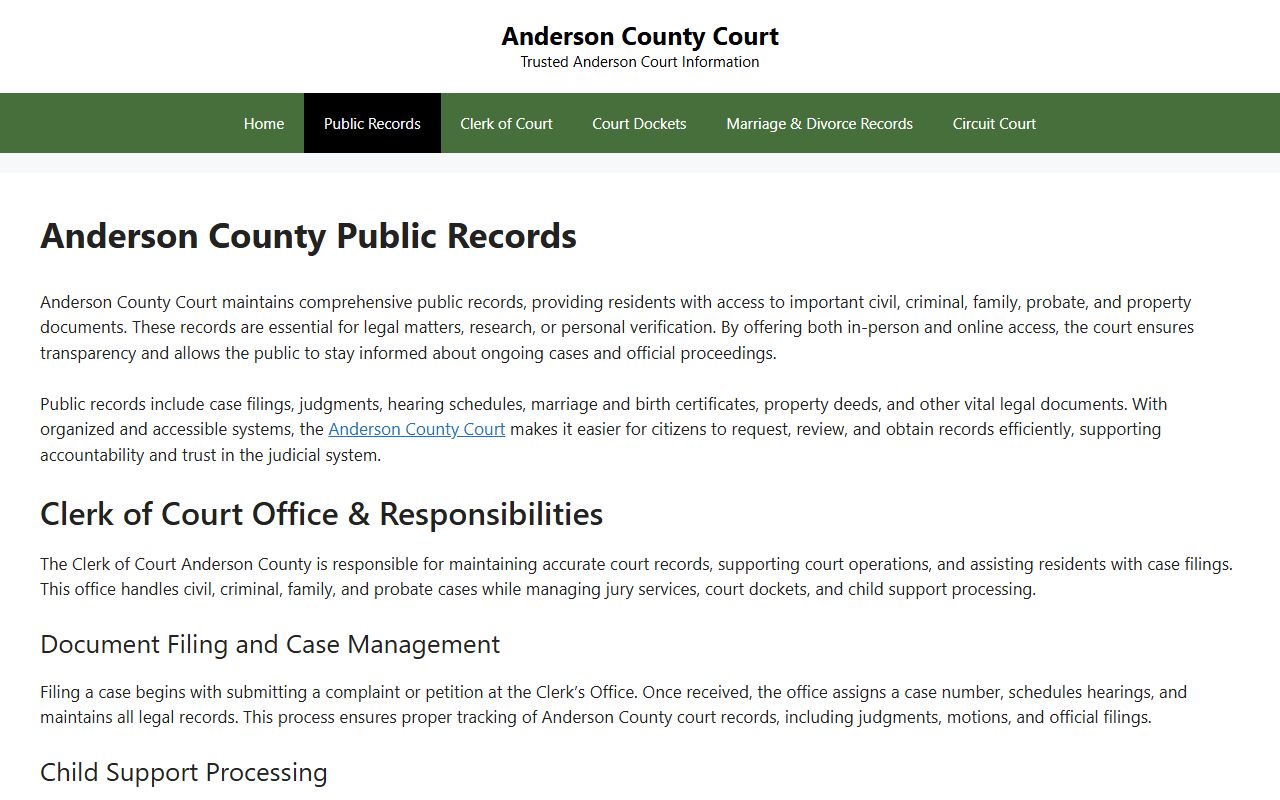
This resource at andersoncountycourts.org/public-records is the best starting point for identifying which Anderson County records are freely searchable online and which require a formal copy request.
ACPASS Database and Anderson County Record Search
Anderson County's ACPASS (Anderson County Public Access Support System) database is an additional county-specific tool for searching public records. The ACPASS portal at acpass.andersoncountysc.org allows searches across multiple record types within Anderson County's own data systems.
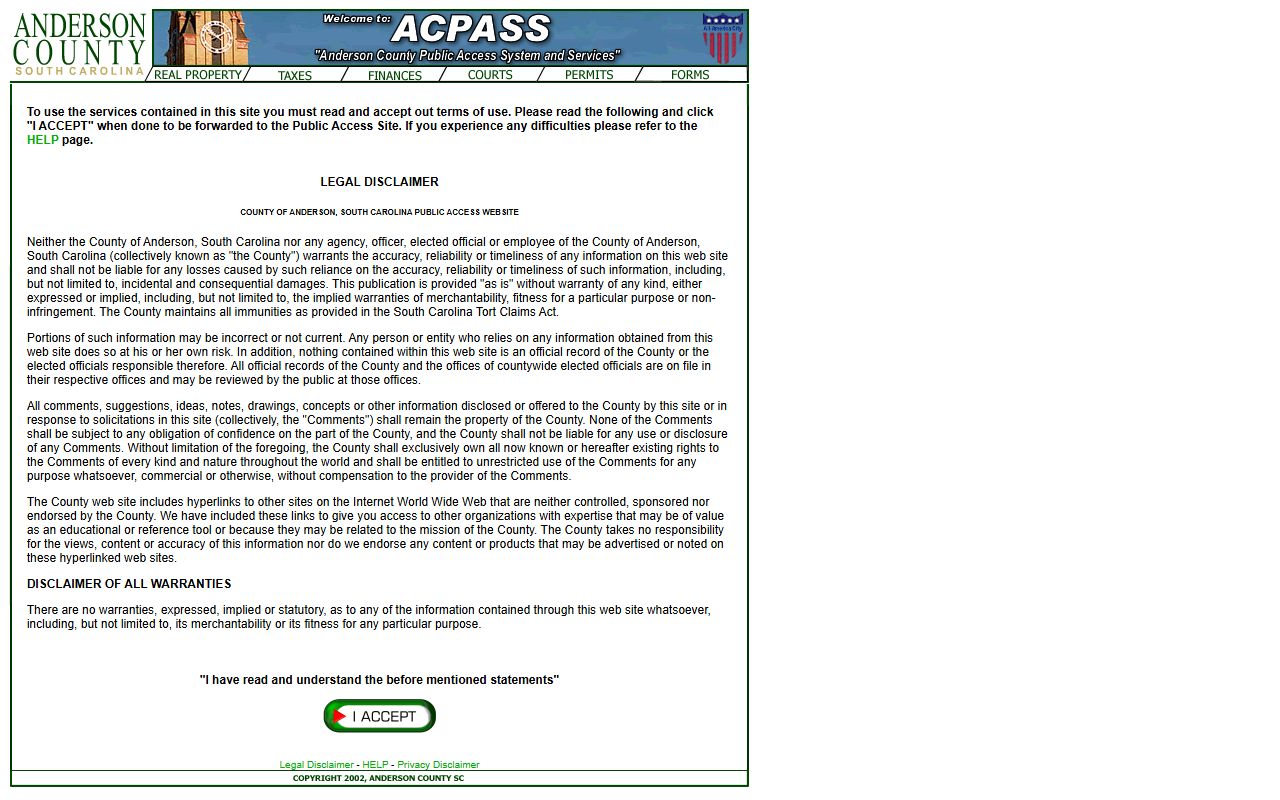
ACPASS is particularly useful for researchers who want to cross-reference Anderson County bankruptcy records with local tax and property data that may not appear in the state Public Index or PACER.
Public Access and FOIA for Anderson County Records
Federal bankruptcy records are governed by federal public access rules, with PACER as the primary access mechanism. For state-level records held by the Anderson County Clerk of Court and Register of Deeds, South Carolina's Freedom of Information Act at S.C. Code Title 30 Chapter 4 applies. Public bodies must respond to records requests within 10 business days and produce records within 30 days. In-person inspection of public records is generally free under Section 30-4-30(A). Certified copies carry per-page fees that vary by office and document type.
Anderson County provides relatively broad online access to its court records through the Public Index, ACPASS, and the county courts portal. Most records identifying party names, case types, judge assignments, and docket actions are viewable online without any registration or fee. Certified copies for legal purposes must be obtained from the Clerk's office at 100 South Main Street in Anderson. The SC Courts website at sccourts.org provides a public index and courthouse directory that can help identify which office maintains a specific Anderson County record type.
Legal Help for Anderson County Bankruptcy Filers
Anderson County residents who need help understanding or filing bankruptcy can contact SC Legal Services at 1-888-346-5592 for free legal assistance if they meet income guidelines. SC Legal Services handles bankruptcy counseling and can advise on South Carolina exemptions that protect certain property during a bankruptcy case. The South Carolina Bar lawyer referral service at 803-799-7100 or 1-800-868-2284 can connect Anderson County residents with licensed bankruptcy attorneys, with initial consultations at $50 for 30 minutes. Attorneys familiar with the Greenville Division of the federal bankruptcy court can provide advice specific to how Anderson County cases are handled.
Cities in Anderson County
Anderson County includes the city of Anderson, with all bankruptcy and court filings from the county processed through the Clerk of Court and the Greenville Division of the federal bankruptcy court.
Nearby Counties
Bankruptcy filings and property liens sometimes span county lines. Check adjacent county records when a debtor had assets or legal proceedings in neighboring jurisdictions.