
Anderson Bankruptcy Records
Anderson is the county seat of Anderson County and a major city in the Upstate South Carolina region. All bankruptcy cases filed by Anderson residents and businesses are handled by the U.S. Bankruptcy Court for the District of South Carolina under the 10th Judicial Circuit. Anderson benefits from a well-organized county court system with robust online access to public records, managed through the Anderson County Clerk of Court. This guide covers how to use PACER, the VCIS phone system, the county's public records portal, and the Anderson Municipal Court to find and verify bankruptcy case information.
Anderson Quick Facts
Federal Bankruptcy Court for Anderson County Filings
Every bankruptcy case originating in Anderson is processed through the U.S. Bankruptcy Court for the District of South Carolina. The state operates as a single unified federal district. Anderson County falls within the Upstate region, and cases are typically assigned to the Greenville Division at 300 E Washington Street, Greenville SC. The court's case information portal at scb.uscourts.gov/case-information provides basic lookup by debtor name or case number.
For full document access, registration with PACER is required. PACER charges $0.10 per page for document downloads, with all fees waived when total quarterly charges stay below $30.00. Most individual case lookups result in no charge. The system provides access to the complete docket including petitions, creditor matrices, trustee reports, objections, and final discharge orders. PACER sends automated email alerts to registered users when activity is posted in a case they are monitoring.
Note: The Greenville Division courthouse serves multiple Upstate counties, and case assignment to Greenville does not require Anderson residents to appear physically in Greenville for all hearings, as some matters are handled by mail or telephonically.
Anderson County Clerk of Court
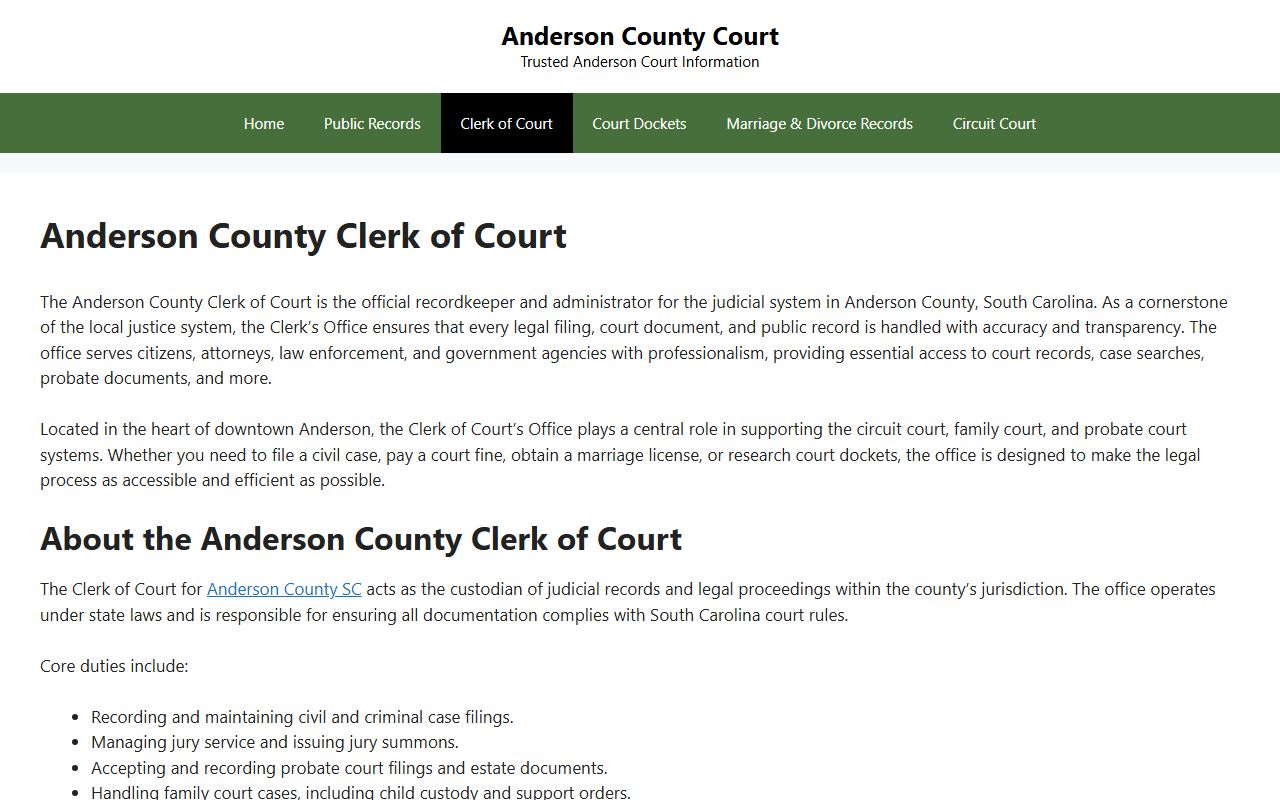
The Anderson County Clerk of Court is C. Reena Thomason, located at 100 South Main Street, Anderson SC 29624, reachable at (864) 260-4053. Office hours are Monday through Friday, 8:30 AM to 5:00 PM. The Clerk's office manages all state court records for the 10th Judicial Circuit and serves as the repository for civil judgments, General Sessions criminal records, and family court filings for Anderson County.
The Anderson County Clerk of Court office at 100 South Main Street manages circuit court records for the 10th Judicial Circuit, including civil judgment records relevant to bankruptcy research.
Civil judgments entered against Anderson residents in circuit court can create liens on real property owned in Anderson County. When an Anderson debtor subsequently files bankruptcy, these liens must be scheduled in the petition's list of secured creditors. Creditors who obtained judgments before the bankruptcy filing should monitor the case through PACER to determine whether their lien will survive the discharge or needs to be addressed through a separate lien avoidance proceeding.
Note: The Anderson County Clerk's office is also the filing point for appeals from lower-level courts including magistrate courts and the Anderson Municipal Court.
Anderson County Courts Online Portal
Anderson County offers strong online access to court records through its dedicated portal at andersoncountycourts.org. The portal allows users to search court records by name, case number, or filing date. Most court records are available through the online system, reducing the need for in-person courthouse visits for routine research tasks.
The Anderson County Courts online portal provides searchable access to civil and criminal case records for the 10th Judicial Circuit.
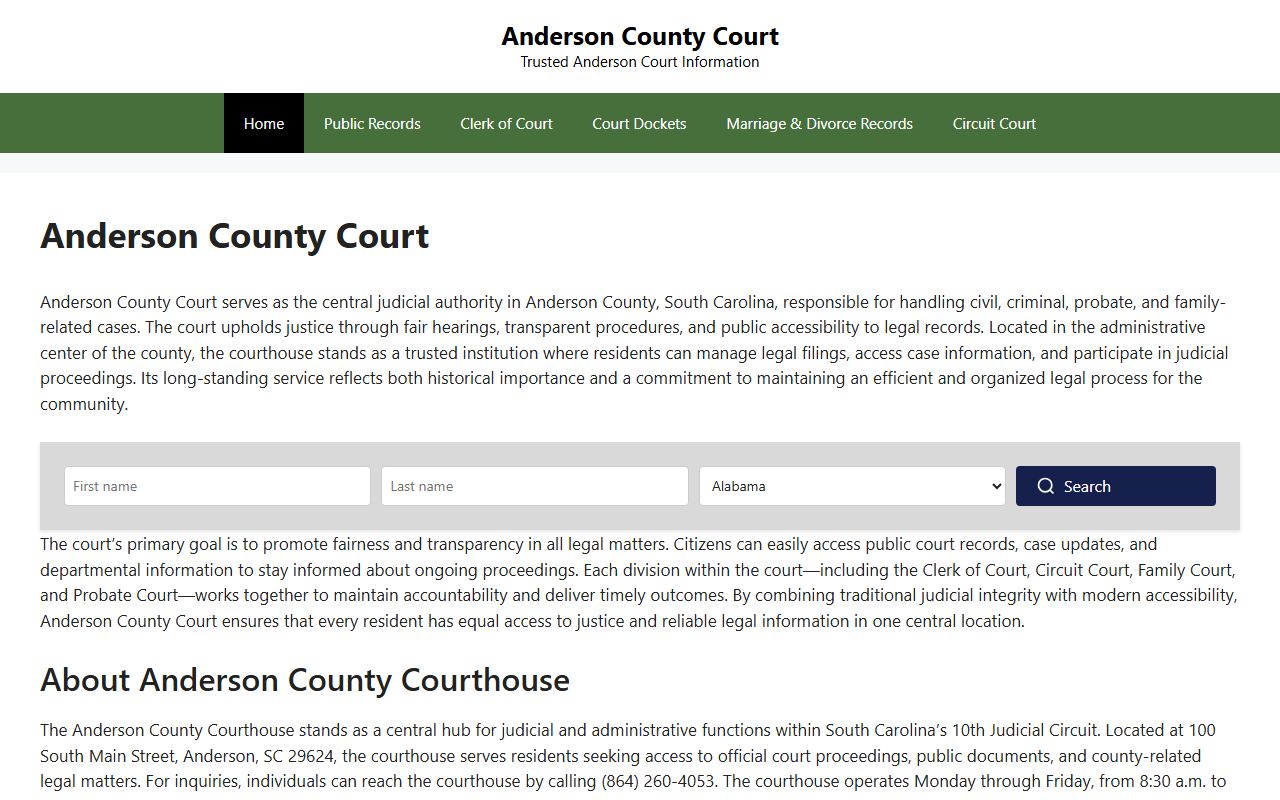
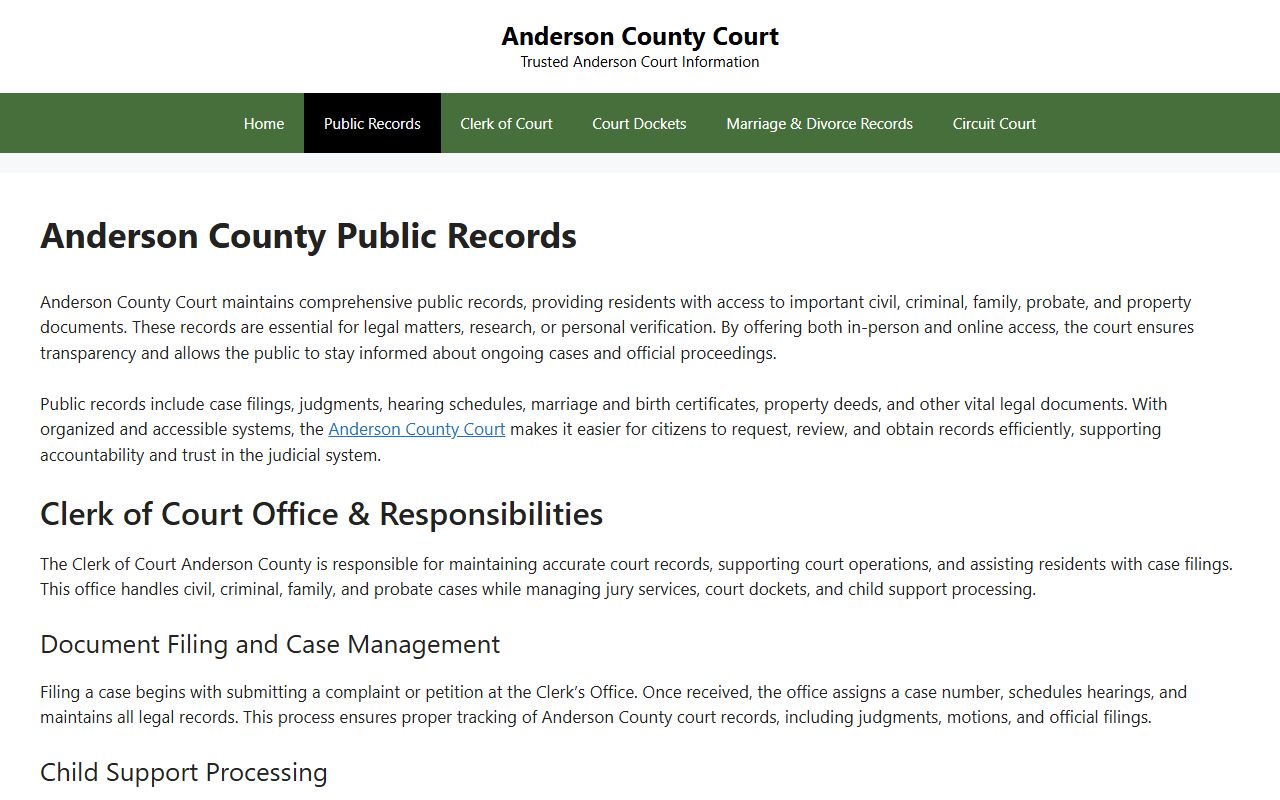
The public records section of the portal at andersoncountycourts.org/public-records/ provides specific guidance on what records are available and how to access them. Creditors researching Anderson debtors can use the portal to locate civil judgments, liens, and case histories without making a written FOIA request for basic case information. More detailed document requests may require either an in-person visit or a written request to the Clerk's office.
Note: The Anderson County online courts portal is maintained separately from the federal PACER system; records on the county portal reflect state court filings only, not federal bankruptcy cases.
Anderson Municipal Court
The Anderson Municipal Court is located at 401 S Main Street, Anderson SC 29624. Court staff include Kimberly Poulin as Court Administrator (primary contact), along with Dorene Fortney, Anna Graham, Holly Mitchell, and Nora Punales. The court handles city ordinance violations, traffic matters, and misdemeanor cases within Anderson city limits.
The Anderson County courts portal also includes a database search interface that provides additional tools for locating case records across different court levels in the county.
Under S.C. Code § 14-25-45, the Anderson Municipal Court is a court "not of record," consistent with all South Carolina municipal courts. This means that proceedings are not stenographically transcribed and appeals proceed to the Court of Common Pleas within the 10th Judicial Circuit by filing a Notice of Appeal with the Anderson County Clerk. Municipal court matters are entirely separate from federal bankruptcy proceedings and do not appear in the federal docket.
Note: Anderson Municipal Court fines are processed through the city's financial system and are not part of the state circuit court judgment index maintained by the Anderson County Clerk.
Anderson County Register of Deeds and Historical Records
The Anderson County Register of Deeds is an appointed office located at 101 S. Main Street, Box 8002, Anderson SC 29622, reachable at (864) 260-1052. The Register maintains real property transaction records for Anderson County, including deeds, mortgages, and recorded liens. These records are essential for bankruptcy research involving Anderson real property, as mortgage liens and judgment liens recorded against county properties must be accounted for in any bankruptcy petition.
A historically notable feature of Anderson County's land records is that the Register of Deeds holds Pendleton District land records from 1789 to 1826, which predate the county's formation and cover what is now Anderson and Pickens counties. This makes Anderson County a valuable research destination for genealogists and title researchers examining early Upstate South Carolina property ownership.
Note: The Anderson County Register of Deeds online search portal allows property record lookups without an in-person visit, though certified copies of recorded instruments require a fee payable to the Register's office.
Legal Resources and Free Bankruptcy Assistance in Anderson
Anderson residents considering bankruptcy can contact the South Carolina Bar at 803-799-7100 for referrals to licensed bankruptcy attorneys practicing in the 10th Judicial Circuit and Upstate federal courts. The Bar's referral service connects callers with practitioners screened for experience in consumer and business bankruptcy matters. For qualifying low-income residents, SC Legal Services at 1-888-346-5592 provides free legal assistance including petition preparation and pre-filing consultation services.
South Carolina saw a 12 percent increase in bankruptcy filings between 2024 and 2025. The SC Tax Lien Registry at dor.sc.gov/LienRegistry should be checked before filing to identify outstanding state tax liens, as these claims receive priority treatment in the bankruptcy distribution hierarchy. The free VCIS line at 1-866-222-8029 remains available 24/7 for quick case status verification without PACER registration. The South Carolina Department of Archives and History holds historical court and property records for researchers examining Anderson County's extensive pre-digital legal history.
Note: Residents filing bankruptcy in Anderson must complete pre-filing credit counseling from a court-approved provider within 180 days before the petition date, and the completion certificate is a required part of the filing package.
Anderson County Court Resources
All Anderson bankruptcy cases are filed with the U.S. Bankruptcy Court for the District of South Carolina and processed through the Anderson County court system.