
Edgefield County Bankruptcy Records
Edgefield County sits in the western Piedmont of South Carolina and is one of the state's original counties formed in 1785 from the old Ninety-Six District. The county is historically significant as the birthplace of ten South Carolina governors, making it the most politically prolific county in state history. Today its Clerk of Court, Sonny Reel, maintains court and land records alongside Register of Deeds functions from offices at 129 Courthouse Square in Edgefield. Bankruptcy filings by Edgefield County residents pass through the U.S. Bankruptcy Court for the District of South Carolina, and this guide explains how to find those records, understand the filing process, and locate legal assistance in the region.
Edgefield County Quick Facts
Federal Bankruptcy Court for Edgefield County Residents
All bankruptcy petitions filed by Edgefield County residents are handled by the U.S. Bankruptcy Court for the District of South Carolina. South Carolina operates as a single federal bankruptcy district, meaning every petition flows through the same administrative system regardless of the county of origin. The court maintains staffed divisions in Columbia at 1100 Laurel Street, Charleston at 145 King Street, and Greenville at 300 East Washington Street. The Columbia division is the closest to Edgefield County and handles the majority of filings from the western midlands and Piedmont areas.
Chapter 7 bankruptcy, the most common type filed by individuals, can produce a discharge of eligible unsecured debts in as little as 90 to 120 days if the case proceeds without objections. Chapter 13 bankruptcy involves a court-confirmed repayment plan lasting 36 to 60 months, suited for filers with regular income who wish to catch up on secured debts such as a mortgage or vehicle loan. South Carolina saw a roughly 12 percent increase in bankruptcy filings from 2024 to 2025, consistent with economic pressures affecting both rural and suburban communities. Edgefield County filers must meet the same federal eligibility requirements, credit counseling prerequisites, and exemption rules as all South Carolina debtors.
Note: South Carolina does not allow debtors to use the federal exemption scheme; state exemptions apply, so understanding what property is protected requires reviewing SC-specific rules.
Searching Edgefield County Bankruptcy Records Online
The image below is drawn from the South Carolina courts system, which provides the public index tool used to search local circuit court records across all counties including Edgefield.
The South Carolina Judicial Department website maintains the statewide Public Index system, which allows free searches of circuit court records for all 46 counties and provides access to case filing information maintained at the local level.
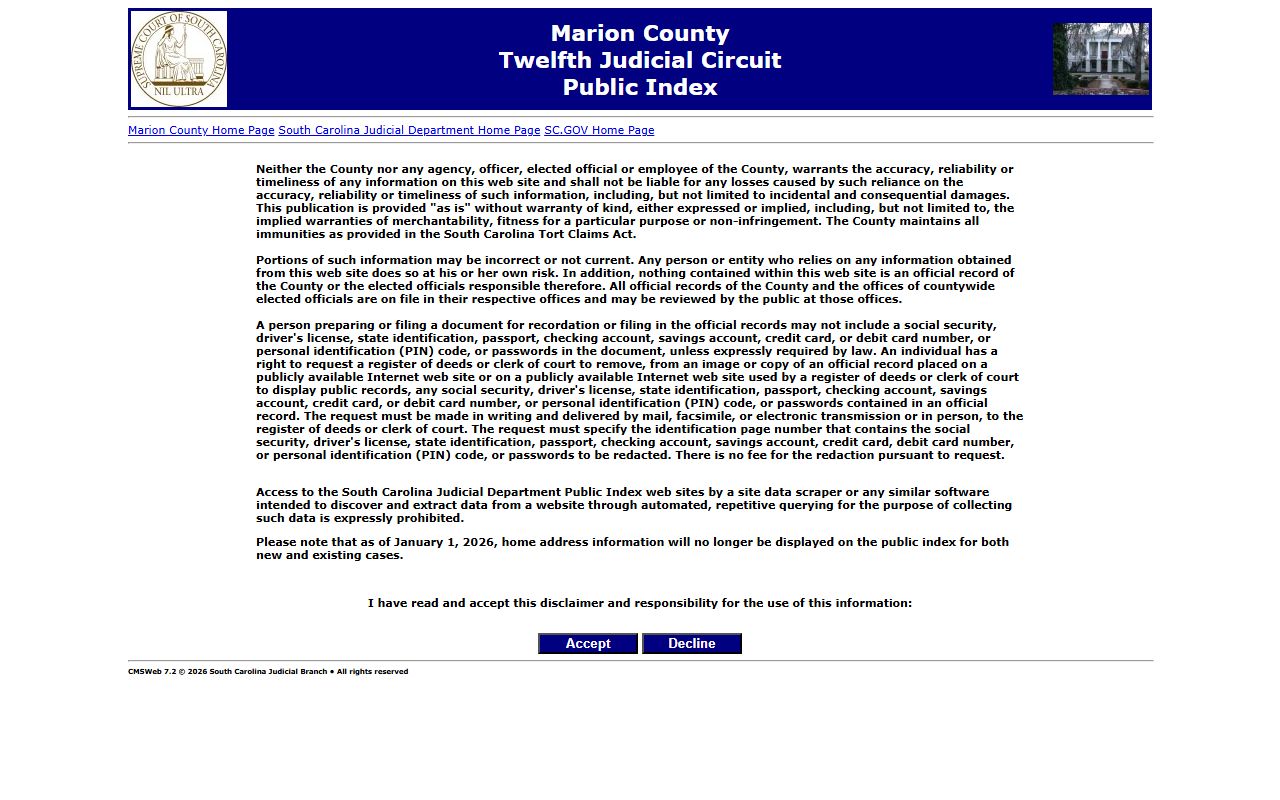
The SC Judicial Public Index is the entry point for state circuit court data, and it complements federal PACER access by covering state civil matters that sometimes accompany bankruptcy proceedings.
For federal records, PACER is the definitive tool. After registering a free account, users can search by debtor name or case number within the South Carolina Bankruptcy Court, retrieve docket entries, and download filed documents for $0.10 per page. Charges are waived in any quarter where total usage stays under $30, making occasional searches effectively free. The Edgefield County Public Index covers state circuit court proceedings and is searchable at no cost. It does not include federal bankruptcy filings, but it can reveal judgment liens, civil suits, and foreclosure actions that often accompany a bankruptcy case. For around-the-clock free case status, the Voice Case Information System at 1-866-222-8029 is available 24 hours a day and covers cases filed after November 30, 1988.
Note: Searching both PACER and the state Public Index together gives the most complete picture of a party's legal history across both state and federal court systems.
Edgefield County Clerk of Court and Record Access
The Clerk of Court office is located at 129 Courthouse Square, Edgefield SC 29824, reachable at (864) 638-4280, Monday through Friday from 8:30 AM to 5:00 PM. Sonny Reel serves as Clerk and performs all Register of Deeds functions for the county, meaning land transactions, mortgage recordings, and deed filings are all handled within the same office. The county website at edgefieldcounty.sc.gov provides contact information and links to department pages.
Digital court and land records in Edgefield County begin in 1913, though physical paper records may be available for earlier periods at the courthouse and through the South Carolina Department of Archives and History. Records created before the formation of Saluda County in 1896 and McCormick County in 1916 include documents that now relate to those neighboring jurisdictions. Researchers tracing title chains or court histories involving those areas should consult Edgefield County records for pre-split filings. The Ninety-Six District records that predate Edgefield County's 1785 formation are housed in Abbeville County, making that archive another useful starting point for very early research.
Note: Property records tied to the McCormick County area that predate 1916 will be found in Edgefield County's archive rather than McCormick's own office.
Historical Context and County Formation
Edgefield County was formed in 1785 from the Ninety-Six District as one of the original counties established when South Carolina reorganized its judicial districts after the American Revolution. The county's political history is exceptional: it produced ten South Carolina governors over its history, a record unmatched by any other county in the state. That legacy reflects the county's early dominance in state politics and the prominence of its landholding families during the antebellum period.
Two counties were later carved from Edgefield. Saluda County was separated in 1896, and McCormick County followed in 1916, taking portions of Edgefield along with parts of Abbeville and Greenwood. For record research purposes, this history matters because filings made before those separations will appear in Edgefield County's archive rather than in the successor counties. The South Carolina Department of Archives and History can help researchers identify which record sets transferred, if any, and which remain in Edgefield. For federal records from early bankruptcy proceedings, the National Archives Southeast Region in Atlanta holds district court records that may include early South Carolina bankruptcy cases not yet digitized into PACER.
Note: The SCDAH online catalog includes manuscript collections and microfilm guides that can help bridge gaps between county archives and statewide record holdings.
Legal Assistance and Financial Guidance for Edgefield County
Residents of Edgefield County seeking legal help with bankruptcy matters can contact the South Carolina Bar Lawyer Referral Service at 803-799-7100 or 1-800-868-2284. The service connects callers with licensed South Carolina attorneys practicing in bankruptcy law. An initial consultation costs $50 for 30 minutes, which allows a prospective filer to discuss their financial situation and get preliminary advice on whether bankruptcy is appropriate and which chapter to consider. For residents who cannot afford private legal fees, SC Legal Services at 1-888-346-5592 provides free civil legal assistance to individuals who meet income guidelines, covering bankruptcy petition preparation and creditor negotiations.
All bankruptcy debtors in South Carolina must complete an approved credit counseling course within 180 days before filing and a debtor education course before receiving a discharge. These courses are available from approved providers, many of which offer online completion. The U.S. Bankruptcy Court's website at scb.uscourts.gov/case-information provides links to approved providers and additional guidance for pro se filers navigating the system without an attorney.
Note: SC Legal Services serves all 46 counties in South Carolina, so Edgefield County residents in rural areas can receive assistance by phone without traveling to a physical office.
Property and Lien Records in Edgefield County
When an Edgefield County bankruptcy case involves real property, researchers should search the county land records maintained by the Clerk of Court in addition to reviewing federal filings in PACER. The SC Land Records database offers a statewide search tool that includes digitized Edgefield County instruments filed within the online system's coverage period. For state tax liens filed after November 1, 2019, the South Carolina Tax Lien Registry at the Department of Revenue is the authoritative source, as those liens are no longer recorded at the county Register of Deeds office. Older state tax liens recorded before that date remain in the county index and can be searched through the Clerk's office or through the SC Land Records portal.
Federal tax liens continue to be recorded with the county Clerk of Court and will appear in the local land records index. During an active bankruptcy case, the automatic stay halts enforcement of both federal and state liens, though the recorded documents themselves remain in the county files. Understanding both the federal court record and the local lien history together gives the most accurate picture of a debtor's property situation.
Note: Digital records in Edgefield County begin in 1996 for land records, so instruments recorded before that date require an in-person review of physical indexes at the courthouse.
Cities in Edgefield County
Edgefield County's municipalities are served by the county clerk system for court and land recording purposes.
Nearby Counties with Bankruptcy Records
Counties bordering Edgefield share many of the same court resources and federal bankruptcy jurisdiction through the District of South Carolina.