
Charleston County Bankruptcy Records
Charleston County is home to one of the most historically significant and administratively complex court systems in South Carolina. Residents of Charleston, North Charleston, Mount Pleasant, and Summerville seeking bankruptcy records can access filings through the U.S. Bankruptcy Court's Charleston Division, located at 145 King Street. The Charleston County Clerk of Court and the Register of Mesne Conveyances together maintain a remarkable archive of court and property records stretching back to 1769, making Charleston County one of the premier repositories for historical legal research in the American South.
Charleston County Quick Facts
Charleston County Clerk of Court
The Charleston County Clerk of Court, currently Julie J. Armstrong, is located at 100 Broad Street, Suite 106, Charleston, SC 29401. The office can be reached by phone at (843) 958-5000 during regular business hours, Monday through Friday, 8:30 AM to 5:00 PM. The Clerk manages all civil and criminal court proceedings within the 9th Judicial Circuit, including Common Pleas, General Sessions, and Family Court matters. Family Court operates out of Suite 143 at the same 100 Broad Street address, while centralized bond hearings are held at 3831 Leeds Avenue, Suite 200, in North Charleston.
The Clerk's office handles jury management, child support records, orders of protection, and grand jury records in addition to the full civil and criminal dockets.
Register of Mesne Conveyances and Property Records
Charleston County uses the historic title "Register of Mesne Conveyances" (RMC) for the office that other South Carolina counties call the Register of Deeds. The RMC maintains all property-related instruments including deeds, mortgages, plats, surveys, and related filings. The RMC office is located at 101 Meeting Street, Room 200, Charleston, SC 29401, and can be reached at (843) 958-4800. Charleston County's property records are among the most extensive in the state, with colonial and antebellum deed books surviving in substantial form and accessible to the public.
When investigating a Charleston County bankruptcy case, the RMC records are essential for identifying real property owned by the debtor, mortgages and other liens encumbering that property, and any recent conveyances that a bankruptcy trustee might scrutinize. Property transfer records showing transactions within the two-year period before a bankruptcy filing can be relevant to fraudulent transfer analysis under the Bankruptcy Code. The SC Land Records site at sclandrecords.com provides online deed and mortgage search capability for Charleston County as a complement to in-person RMC research.
The Charleston County government website hosts access to the Register of Mesne Conveyances and property records, illustrated below.
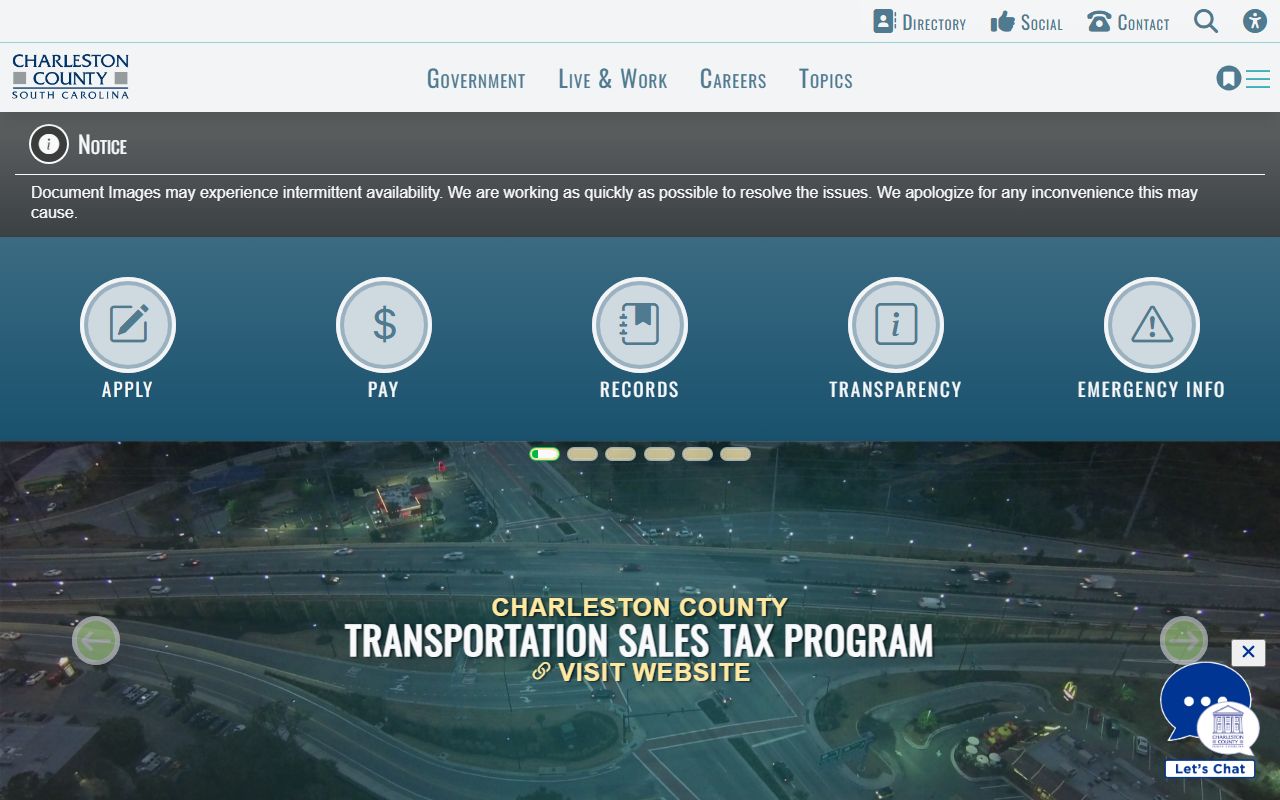
The county website provides online deed search capability, plat access, and information about recording fees and document submission procedures for the RMC office at 101 Meeting Street.
The US Bankruptcy Court Charleston Division
The U.S. Bankruptcy Court for the District of South Carolina maintains its Charleston Division at the King and Queen Building, 145 King Street, Room 225, Charleston, SC 29401. This division serves Charleston County and the surrounding Lowcountry region. Charleston County bankruptcy cases are filed here and assigned to one of the district's bankruptcy judges. The court handles Chapter 7 liquidation cases, Chapter 11 business reorganizations, and Chapter 13 individual debt repayment plans. Given Charleston County's status as South Carolina's most populous county, this division processes a substantial share of the statewide caseload.
Searching Charleston County bankruptcy records through PACER at pacer.uscourts.gov gives researchers access to the complete electronic case file for any case filed since the court's conversion to electronic records. PACER charges $0.10 per page with a maximum of $3.00 per document; quarterly charges under $30.00 are waived entirely. A PACER search can locate cases by debtor name, Social Security number, business name, or case number, and results include the petition, all schedules, the claims register, hearing transcripts, and any orders entered by the court including the final discharge or dismissal order.
For free telephonic case lookups, the Voice Case Information System (VCIS) at 1-866-222-8029 is available around the clock and covers cases filed after November 30, 1988. The VCIS system works well for verifying whether a named individual or business has an active or recently closed Charleston County bankruptcy case without incurring any PACER fees. Additional case information is available at scb.uscourts.gov/case-information.
Charleston County as a Regional Records Repository
Charleston County occupies a unique position in South Carolina's records landscape because it serves as the repository for pre-1882 records of both Berkeley County and Dorchester County. When Berkeley and Dorchester Counties were formed from the Charleston District, their early records remained in Charleston. Researchers tracing property chains or court histories in those neighboring counties for periods before 1882 must consult the Charleston County archives rather than the Berkeley or Dorchester county courthouses. Pre-1785 records for many of South Carolina's coastal counties also originated in the colonial Charleston court system and are preserved here, creating a resource of extraordinary depth for title and debt research.
Charleston County's probate records are considered among the finest in the nation, with probate files dating to the colonial era offering extraordinary detail about estates, debts, inventories, and creditor claims. While probate records are separate from bankruptcy proceedings, they share conceptual territory in documenting how debts are resolved from estates and how assets are distributed among creditors and heirs. Researchers working on complex historical title chains or long-standing debt obligations will find Charleston County's court archives exceptionally well preserved compared to most jurisdictions in the Southeast.
The City of Charleston's court and traffic ticket resources page offers supplementary guidance for city-level public records access, as shown below.
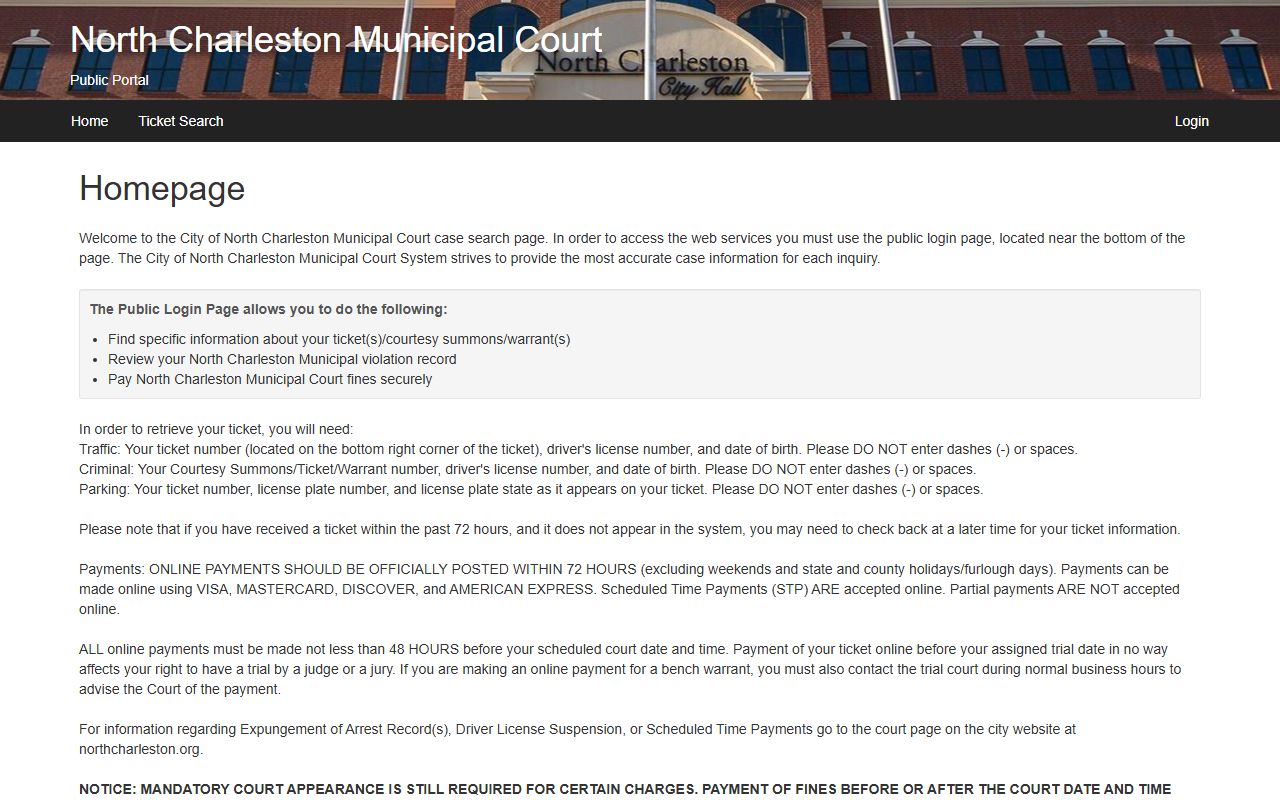
The city-level resource complements the county court system by addressing municipal court matters that operate under S.C. Code Section 14-25-45, which governs municipal and magistrate courts that are not courts of record in South Carolina.
State Tax Liens, UCC Filings, and Bankruptcy Research
State tax liens affecting Charleston County property are recorded through the South Carolina Department of Revenue's online lien registry at dor.sc.gov/LienRegistry. This centralized registry covers state tax liens filed since November 1, 2019, replacing the prior practice of recording such liens at the county level. For bankruptcy research purposes, outstanding state tax liens identified in the DOR registry may constitute priority claims that survive discharge under the Bankruptcy Code's priority scheme for governmental tax debts. Liens predating November 2019 should be searched through the RMC's historical records.
UCC financing statements for Charleston County are filed with both the South Carolina Secretary of State (for statewide UCC-1 filings) and locally with the RMC for fixture filings tied to specific real property. Identifying all UCC filings against a debtor is an important step in evaluating the secured creditor landscape in a Charleston County bankruptcy case. Federal tax liens filed by the IRS are recorded with the Secretary of State and can be searched online as a supplement to the local RMC search.
Public Access Rules, FOIA, and Obtaining Copies
Charleston County court records maintained by the Clerk of Court are subject to the South Carolina Freedom of Information Act, S.C. Code Title 30, Chapter 4. Under this law, public records must be made available within 10 business days of a written request. The Clerk's office at (843) 958-5000 can advise on record availability and applicable copy fees before a formal FOIA request is submitted. Certified copies of court documents carry a fee set by state law, and the Clerk's office can provide a current fee schedule.
Federal bankruptcy court records in the Charleston Division are governed by federal rules. Most documents are publicly accessible through PACER, though certain sensitive information is redacted under Federal Rule of Bankruptcy Procedure 9037. The South Carolina Archives at scdah.sc.gov and the National Archives Atlanta facility at archives.gov/atlanta hold older state and federal court records respectively for cases that predate electronic filing. Researchers with complex historical needs may need to consult both repositories for a complete picture of Charleston County court activity.
Legal Assistance for Charleston County Bankruptcy Matters
The U.S. Bankruptcy Court's FAQ page at scb.uscourts.gov/court-info/faq is an excellent starting point for understanding the bankruptcy process in South Carolina. Chapter 7 cases typically result in a discharge within 90 to 120 days of filing, while Chapter 13 cases involve repayment plans running 36 to 60 months. South Carolina saw roughly a 12 percent increase in bankruptcy filings between 2024 and 2025, and Charleston County accounts for a significant share of those cases given its large population base in the Lowcountry.
South Carolina Legal Services provides free legal help to income-qualifying residents and can be reached at 1-888-346-5592. The South Carolina Bar Lawyer Referral Service connects residents with licensed bankruptcy attorneys; call 803-799-7100 or 1-800-868-2284, or visit scbar.com. Charleston County has a substantial legal community with many attorneys experienced in consumer and business bankruptcy matters serving clients in Charleston, North Charleston, Mount Pleasant, and Summerville.
Cities in Charleston County
Charleston County is the most populous county in South Carolina and includes several major cities and fast-growing communities. The county seat of Charleston is among the oldest cities in North America and remains the center of county government, commerce, and culture. North Charleston is a major urban center in its own right, while Mount Pleasant and Summerville rank among the fastest-growing municipalities in the state.
Nearby Counties
Charleston County borders several counties in the South Carolina Lowcountry. Berkeley and Dorchester Counties share deep historical ties with Charleston, as both were carved from the original Charleston District and their pre-1882 records remain in Charleston County's archives. Colleton and Georgetown Counties border Charleston County to the south and north respectively.