
Find Bankruptcy Records in Allendale County
Allendale County bankruptcy records are maintained within the federal court system and are accessible to the public through PACER and the Voice Case Information System. At the county level, the Allendale County Clerk of Court, Elaine Sabb, serves as the primary local custodian of court and property records, including records that frequently accompany bankruptcy cases such as civil judgments, liens, and deed filings. Allendale County is part of the 14th Judicial Circuit, and all federal bankruptcy cases filed by county residents are processed through the U.S. Bankruptcy Court for the District of South Carolina.
Allendale County Quick Facts
Allendale County Clerk of Court and Local Records
The Allendale County Clerk of Court is the central local resource for court and property records in Allendale County. The office is mailing-addressed at P.O. Box 418, Allendale, SC 29810, with the physical office located at the Allendale County Courthouse. The Clerk can be reached by phone at (803) 584-2732 during regular hours, Monday through Friday, 8:30 AM to 5:00 PM.
In Allendale County, there is no separate Register of Deeds office. The Clerk of Court performs Register of Deeds functions directly, recording and maintaining deeds, mortgages, UCC filings, and land-related documents for the county. This consolidated structure means that researchers looking for property records tied to Allendale County bankruptcy cases need to contact or visit only one office. When a bankruptcy discharge results in a lien release or deed in lieu of foreclosure, that document is filed with the Clerk's office under its ROD function.
The Clerk also manages Circuit Court records for General Sessions and Common Pleas cases, Family Court records, child support processing, and jury management. Civil judgments entered in Allendale County Circuit Court, including those that predate or accompany a bankruptcy filing, are part of the Clerk's civil records and are indexed in the state Public Index.
The South Carolina Courts website provides courthouse and contact information for the Allendale County Clerk, as shown in the resource below.
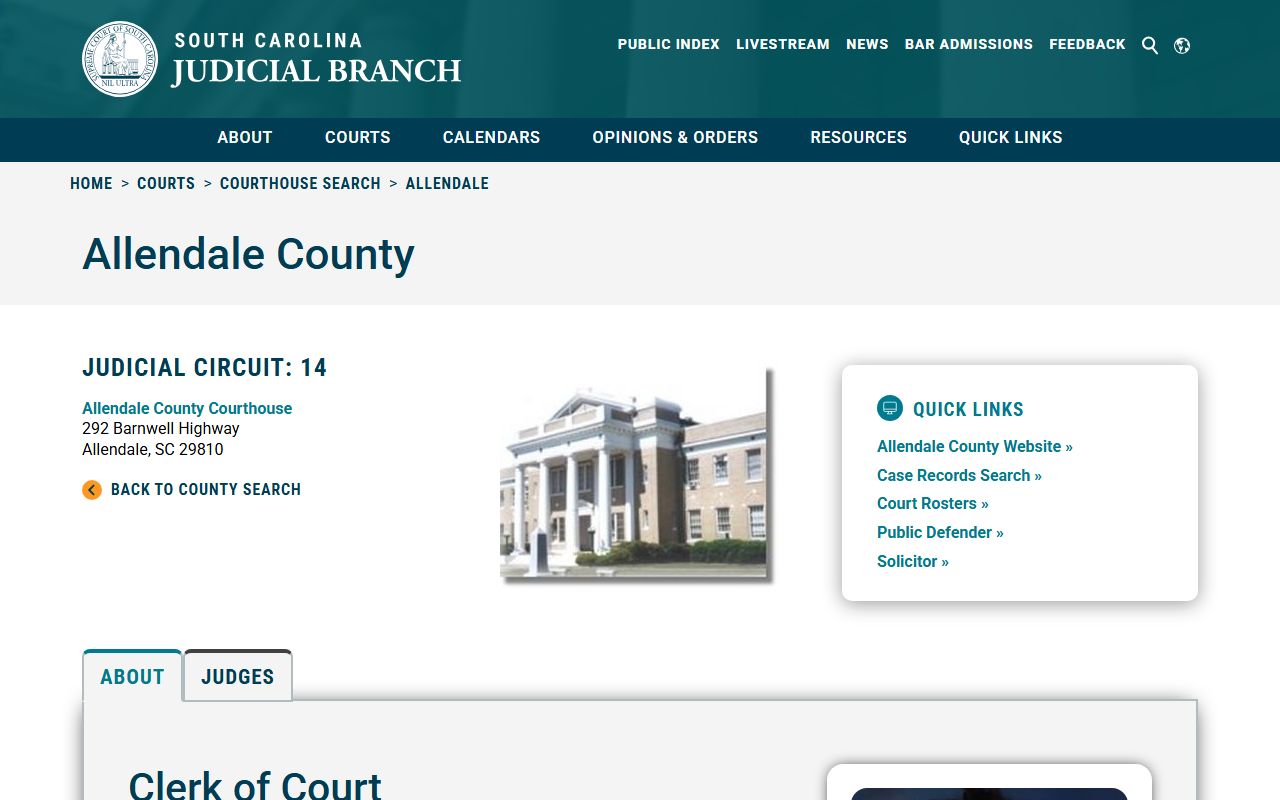
Researchers can use the SC Courts courthouse directory for Allendale County to confirm current addresses, phone numbers, and office hours before visiting in person to review bankruptcy-related records.
How to Search Allendale County Bankruptcy Records
The primary method for searching Allendale County bankruptcy records is through PACER, the federal judiciary's public access system. PACER provides docket sheets, filed documents, and case status for all federal bankruptcy filings. Charges are $0.10 per page with a $3.00 per-document maximum. Quarterly charges under $30.00 are waived automatically, meaning infrequent searches are often free. PACER registration is free and available online.
The Voice Case Information System (VCIS) at 1-866-222-8029 is a free, 24-hour automated phone system that provides basic case information for Allendale County bankruptcy filings going back to November 30, 1988. Callers receive debtor name, case number, filing date, chapter type, trustee assignment, and discharge or dismissal status without any account or fees.
At the county level, the South Carolina Judicial Public Index for Allendale County allows free searches of state court records. This index is useful for locating civil judgments, liens, and other state-court records that may intersect with a federal bankruptcy filing. The Public Index can be searched by party name, case number, date range, or case type with no registration required.
The U.S. Bankruptcy Court's case information portal provides additional access through CM/ECF and WebPacer for registered filers and attorneys handling Allendale County bankruptcy cases.
Types of Bankruptcy Records and Case Information
Allendale County residents file several types of bankruptcy cases under the federal Bankruptcy Code. Chapter 7 liquidation cases are the most frequently filed, discharging eligible unsecured debt after a trustee reviews the debtor's non-exempt assets. Discharge in a typical Chapter 7 case occurs within 90 to 120 days of filing. Chapter 13 repayment plan cases allow individuals with regular income to repay creditors over 36 to 60 months while retaining assets. Chapter 11 is available for businesses seeking reorganization, and Chapter 12 is specifically designed for family farmers and family fishermen.
A complete Allendale County bankruptcy case file contains the original petition, asset and liability schedules, a statement of financial affairs, a creditor matrix, proofs of claim from creditors, trustee reports, and the discharge or dismissal order. All of these documents are accessible through PACER for cases processed by the U.S. Bankruptcy Court for the District of South Carolina. Cases from Allendale County are most likely processed through the Columbia Division at 1100 Laurel Street, though the court's website should be consulted to confirm division assignment for a specific case.
For answers to questions about what each bankruptcy chapter covers and how the process works in South Carolina, the court's FAQ page is a freely available public resource.
Note: Statewide bankruptcy filings in South Carolina increased by approximately 12% from 2024 to 2025, reflecting broader economic pressures affecting rural counties like Allendale.
Allendale County Property and Lien Records
Because the Allendale County Clerk performs ROD functions, all property-related records relevant to bankruptcy cases are held in the same office as the court records. Deeds, mortgages, plats, and UCC filings are all recorded with the Clerk. State tax liens filed before November 1, 2019 may be found in the Clerk's lien records, while liens filed on or after that date are searchable through the SC Department of Revenue Lien Registry. Federal tax liens are recorded with the county and indexed separately.
The SC Land Records portal provides online access to recorded instruments in Allendale County, including documents that may reflect lien releases or deed transfers following a bankruptcy discharge. Researchers comparing Allendale County bankruptcy records with property encumbrances should check both the county-level land records and the SCDOR registry.
Allendale County Records History
Allendale County was created in 1919 from portions of Barnwell County and Hampton County, making it one of the youngest counties in South Carolina. Court records and land records for Allendale County begin in 1919. Researchers seeking records that predate the county's formation must look to Barnwell County or Hampton County, where the predecessor records are held. Both counties maintained their own Clerk of Court offices and ROD functions before Allendale County was carved out.
For historical records that may not be available at the county level, the South Carolina Department of Archives and History holds microfilm and archival collections from across the state. Pre-1995 federal bankruptcy filings from the Allendale County area may also be available through the National Archives Atlanta facility. Allendale County's rural agricultural heritage means that many historical records involve farm property, which can be relevant when tracing liens or ownership claims in bankruptcy proceedings involving rural land.
The U.S. Bankruptcy Court for the District of South Carolina, which serves Allendale County filers, is shown in the reference below.

The court's website at scb.uscourts.gov provides division locations, filing information, forms, and resources for Allendale County bankruptcy filers and researchers.
Public Access and FOIA for Allendale County Records
Federal bankruptcy records are governed by federal public access rules, and PACER is the standard access mechanism for filed documents. State-level records held by the Allendale County Clerk are subject to South Carolina's Freedom of Information Act at S.C. Code Title 30 Chapter 4. Under FOIA, the Clerk must respond to written records requests within 10 business days and produce responsive records within 30 days. In-person inspection of public records at the Clerk's office is generally free, while copies carry a per-page fee.
The Public Index for Allendale County is freely accessible online without registration, providing name and case number searches for most civil and criminal records. Certified copies of court documents must be obtained from the Clerk's office directly. Researchers should contact the Clerk at (803) 584-2732 to confirm current copy fees and available records before visiting the Allendale County Courthouse.
Legal Help for Allendale County Residents
Allendale County residents facing bankruptcy or seeking to understand their options can access free legal assistance through SC Legal Services at 1-888-346-5592. This organization provides legal help to qualifying low-income individuals and can advise on bankruptcy eligibility, exempt assets, and the filing process in South Carolina's federal court system. Given Allendale County's rural character and limited local legal resources, SC Legal Services is an especially important resource for county residents.
The South Carolina Bar lawyer referral service at 803-799-7100 or 1-800-868-2284 can connect residents with licensed bankruptcy attorneys for an initial consultation at $50 for 30 minutes. Attorneys familiar with the Columbia Division of the federal bankruptcy court can provide advice specific to how Allendale County cases are processed. The court's own FAQ resource is freely available and covers the basics of each chapter type.
Note: SC Legal Services covers all South Carolina counties including Allendale, and callers can request services in any language through the organization's intake process.
Cities in Allendale County
Allendale County is a small, rural county with Allendale as its county seat. Bankruptcy and court filings from all parts of the county are processed through the same Clerk of Court office and federal court system.
Nearby Counties
When researching Allendale County bankruptcy records, you may also need to check adjacent counties if a debtor held property or had court cases in neighboring jurisdictions.